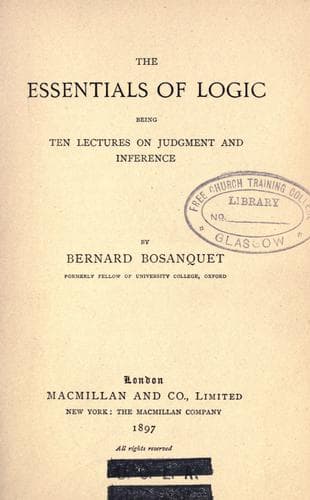
The Essentials of Logic, Being Ten Lectures on Judgment and Inference — John Shaqi
The Essentials of Logic, Being Ten Lectures on Judgment and InferenceBosanquet, Bernard
Philosophy
The Essentials of Logic, Being Ten Lectures on Judgment and Inference
Bosanquet, Bernard
Logic
Thus we have, in our world of will, a parallel case which illustrates
the nature of our world of knowledge. There is the clear will to look
at the picture, the dim will to continue standing, and the implied will
to carry out certain general aims, and follow a certain routine or
course of life, which gives the momentary purpose its entire setting
and background.
I have spoken of the will in order to illustrate the judgment, because
the dim and implied elements are perhaps more easy to observe in the
case of the will. Almost all our common waking life is carried on by
actions such as walking and sitting, which we hardly know that we
will, but which we could not do if we did not will them. And also the
greater part of our life is rather within a sphere of will which has
become objective for us in our profession, interests, and ideals, than
a perpetual active choice between {40} alternatives such as brings the
act of volition before us in the most striking way. Just so it is with
judgment. Our speaking and writing is a very small part of our judging,
just as our conscious choice between alternatives [1] is a very small
part of our willing.
[1] I do not for a moment suggest that our “conscious choice” is
ultimately different in kind from our habitual persistence in a
course of life. I only take it as an instance in which we fully
attend to our volition.
_Distribution of Attention_
6. Thus the world of knowledge and the world of will must each of them
be regarded as a _continuum_ for the waking consciousness. Whenever
we are awake, we are judging; whenever we are awake we are willing.
The distribution of attention in these two worlds is very closely
analogous. In both, it is impossible to attend to our whole world at
the same moment. But in both, our world is taken as being a single
connected system; and therefore (i.) attention shades off gradually
from the momentary focus of illumination into less and less intensity
over the other parts of the continuous judgment or purpose; but (ii.)
that which is _in_ the focus of attention depends for its quality upon
that which is less distinctly or not at all in the focus of attention.
And as attention diminishes in intensity, the implication of reality
does not diminish with it. In other words, in spite of the inequality
of attention, the reality of our whole world is implied in the reality
of which at any moment we are distinctly aware. But being distinctly
aware of reality is another name for judgment.
Public-domain text, read in full here on John Shaqi.
Reviews
Reviews
No reviews yet
Be the first to share your thoughts on this work.
Join the Discussion
Join the discussion
Sign in to leave a comment or review.
Sign InorCreate an account