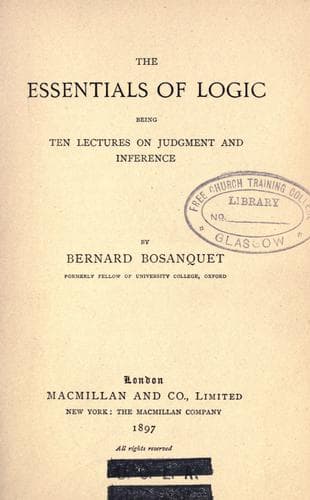
The Essentials of Logic, Being Ten Lectures on Judgment and InferenceBosanquet, Bernard
Philosophy
The Essentials of Logic, Being Ten Lectures on Judgment and Inference
Bosanquet, Bernard
Logic
Now the common logical judgments which we shall have to analyse
and classify are simply those parts of this continuous affirmation
of consciousness which are from time {41} to time separately made
distinct. Each of them therefore must be regarded as a partial
expression of the nature of reality, and the subject will always be
Reality in one form, and the predicate reality in another form. The
ultimate and complete judgment would be the whole of Reality predicated
of itself. All our logical judgments are such portions and fragments
of this judgment as we can grasp at the moment. Some of these gather
up in a system whole provinces of reality, others merely enlarge,
interpret, or analyse the content of a very simple sense-perception.
We shall not go far wrong in practice if we start from this judgment
of Perception as the fundamental kind of Judgment. The real subject in
Judgment is always Reality in some particular datum or qualification,
and the tendency of Judgment is always to be a definition of Reality.
We see the parts of Judgment most clearly in such thoughts as “This is
blue”; “This is a flower”; “That light is the rising sun”; “That sound
is the surf on a sandy shore.” In these we can plainly distinguish the
element of presentation and the interpretative construction or analytic
synthesis which is by the judgment identified with it.
{42}
LECTURE III THE RELATION OF LOGIC TO KNOWLEDGE
_Meaning of “Form”_
1. I spoke of the whole world, which we take to be real, as presented
to us in the shape of a continuous judgment. It is the task of Logic
to analyse the structure of this Judgment, the parts of which are
Judgments.
The first thing is then to consider what sort of properties of
Judgments we attend to in Logic. It is commonly said that Logic is a
formal science; that is, that it deals with the form, and not with the
content or matter of knowledge.
This word “form” is always meeting us in philosophy. “Species” is Latin
for form, as εἶδος and ἰδεα [1] are Greek for form. The form of any
object primarily means its appearance, that which the mind can carry
away, while the object as a physical reality, as material, remains
where it was. It need not mean shape as opposed to colour; that is a
narrower usage. The Greek opinion was no doubt rooted in some such
notion as that in knowing or remembering a thing the mind possessed
its form or image without its matter. Thus the form came to stand for
the knowable shape or structure which makes a thing what it is, and by
which we recognise it when we see it. This was its species or its idea,
the “image,” as it is used in the phrase, “Let us make man in our own
image.” So in any work of the hands {43} of man, the form was the shape
given by the workman, and came out of his mind, while the matter was
the stuff or material out of which the thing was made.
[1] [= “eidos” and “idea”. Tr.]
Public-domain text, read in full here on John Shaqi.
Reviews
Reviews
No reviews yet
Be the first to share your thoughts on this work.
Join the Discussion
Join the discussion
Sign in to leave a comment or review.
Sign InorCreate an account