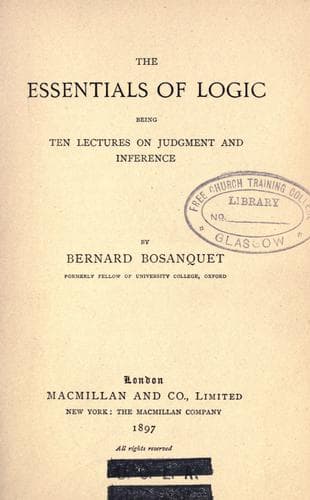
The Essentials of Logic, Being Ten Lectures on Judgment and InferenceBosanquet, Bernard
Philosophy
The Essentials of Logic, Being Ten Lectures on Judgment and Inference
Bosanquet, Bernard
Logic
The moment we contemplate a classification of the sciences, we see
that this is a purely relative distinction. There is no matter without
form. If it was in this deep sense without form, it would be without
properties, and so incapable of acting or being acted upon. In a
knife the matter is steel, the form is the shape of the blade. But
the qualities of steel again depend, we must suppose, upon a certain
character and arrangement in its particles, and this is, as Bacon would
have called it, the _form_ of steel. But taken as purely relative,
the distinction is good _prima facie_. Steel has its own form, but
the knife has its form, and the matter steel can take many other
forms besides that of a knife. Marble has its own form, its definable
properties as marble (chemical and mechanical), but in a statue, marble
is the matter, and the form is the shape given by the sculptor.
Now applying this distinction to knowledge in general, we see that
all science is formal, and therefore it is no distinction to say that
Logic is a formal science. Geometry is a formal science; even molecular
physics is a formal science. All science is formal, because all science
consists in tracing out the universal characteristics of things, the
structure that makes them what they are.
The particular “form,” then, with which a science deals is simply the
kind of properties that come under the point of view from which that
science in particular looks at things. But a very general science is
more emphatically formal than {44} a very special science. That is to
say, it deals with properties which are presented in some degree by
everything; and so in every object a great multitude of properties
are disregarded by it, are treated by it as matter and not as form.
In this sense Logic is emphatically “formal,” though not nearly so
formal as it is often supposed to be. The subject-matter of Logic,
then, is Knowledge _qua_ Knowledge, or the form of knowledge; that is,
the properties which are possessed by objects or ideas _in so far as
they are members of the world of knowledge_. And it is quite essential
to distinguish the form of knowledge in this sense from its matter or
content. The “matter” of knowledge is the whole region of facts dealt
with by science and perception. If Logic dealt with this in the way in
which knowledge deals with it, _i.e._ simply as a process of acquiring
and organising experience, then Logic would simply be another name for
the whole range of science, history, and perception. Then there would
be no distinction between logic and science or common sense, and in
trying to ascertain, say, the wave-length of red light, or the cab-fare
from Chelsea to Essex Hall, we should be investigating a logical
problem. But we see at once that this is not what we mean by studying
knowledge as knowledge. Science or common sense aims at a particular
answer to each problem of this kind. Logic aims at understanding
Public-domain text, read in full here on John Shaqi.
Reviews
Reviews
No reviews yet
Be the first to share your thoughts on this work.
Join the Discussion
Join the discussion
Sign in to leave a comment or review.
Sign InorCreate an account