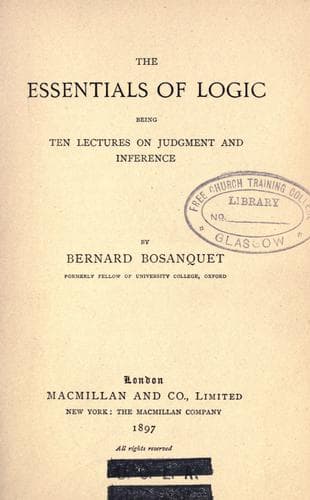
The Essentials of Logic, Being Ten Lectures on Judgment and Inference — John Shaqi
The Essentials of Logic, Being Ten Lectures on Judgment and InferenceBosanquet, Bernard
Philosophy
The Essentials of Logic, Being Ten Lectures on Judgment and Inference
Bosanquet, Bernard
Logic
the type and principles both of the problem and of its answer. The
details of the particular answer are the “_matter_ of fact.” The type
and principles which are found in all such particular answers may be
regarded as the form of fact, _i.e._ that which makes the fact a fact
in knowledge.
Jevons appears to me to make a terrible blunder at this {45} point. He
says [1]--“One name which has been given to Logic, namely the Science
of Sciences, very aptly describes the all-extensive power of logical
principles. The cultivators of special branches of knowledge appear
to have been fully aware of the allegiance they owe to the highest
of the sciences, for they have usually given names implying this
allegiance. The very name of Logic occurs as part of nearly all the
names adopted for the sciences, which are often vulgarly called the
‘ologies,’ but are really the ‘logics,’ the ‘o’ being only a connecting
vowel or part of the previous word. Thus geology is logic applied to
explain the formation of the earth’s crust; biology is logic applied
to the phenomena of life; psychology is logic applied to the nature
of the mind; and the same is the case with physiology, entomology,
zoology, teratology, morphology, anthropology, theology, ecclesiology,
thalattology, and the rest. Each science is thus distinctly confessed
to be a special logic. The name of Logic itself is derived from the
common Greek word λόγος, which usually means _word_, or the sign and
outward manifestation of any inward thought. But the same word was
also used to denote the inward thought or reasoning of which words are
the expression, and it is thus probably that later Greek writers on
reasoning were led to call their science ἐπιστήμη λογική, or logical
science, also τέχνη λογική or logical art. [2] The adjective λογική,
being used alone, soon came to be the name of the science, just as
Mathematic, Rhetoric, and other names ending in ‘ic’ were originally
adjectives, but have been converted into substantives.”
[1] _Elementary Lessons_, p. 6.
[2] [= “logos”, “episteme logike”, “techne logike” and “logike”. Tr.]
Public-domain text, read in full here on John Shaqi.
Reviews
Reviews
No reviews yet
Be the first to share your thoughts on this work.
Join the Discussion
Join the discussion
Sign in to leave a comment or review.
Sign InorCreate an account