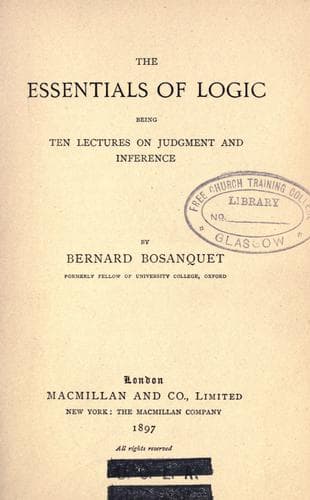
The Essentials of Logic, Being Ten Lectures on Judgment and Inference — John Shaqi
The Essentials of Logic, Being Ten Lectures on Judgment and InferenceBosanquet, Bernard
Philosophy
The Essentials of Logic, Being Ten Lectures on Judgment and Inference
Bosanquet, Bernard
Logic
{46} This account of the connection between the name “Logic” and the
terminations of the names of the sciences appears precisely wrong.
Whatever may have been the exact meaning of the expression “Logic,”
or “Logical curriculum,” [1] or “art,” or “science” when first
employed, there can be no doubt that the word logical had a substantive
reference to that about which the science or teaching in question
was to treat. The term “logic,” therefore, corresponds not to the
syllables “logy” in such a word as “Zoology,” but to the syllables
“Zoo,” which indicate the province of the special science, and not
its character as a science. Zoology means connected discourse (λόγος)
about living creatures. Logic meant a curriculum, or science or art
dealing with connected discourse. The phrase “Science of Sciences,”
rightly interpreted, has the same meaning. It does not mean that Logic
is a Science which comprises all the special sciences, but that Logic
is a Science dealing with those general properties and relations which
all sciences _qua_ sciences have in common, but omitting, as from its
point of view matter and not form, the particular details of content by
which every science answers the particular questions which it asks. It
is wild, and most mischievous, to say that “every science is a special
logic,” or that “biology is Logic applied to the phenomena of life.”
This confusion destroys the whole disinterestedness which is necessary
to true scientific Logic, and causes the logical student always to have
his eye on puzzles, and special methods, and interferences by which he
may teach the student of science how to perform the concrete labour
of research. We quite admit that {47} a looker-on may _sometimes_ see
more of the game, and no wise investigator would contemn _a priori_
the suggestions of a student like Goethe, or Mill, or Lotze, because
their author was not exclusively engaged in the observation of
nature. But all this is secondary. The idea that Logic is a judge of
scientific results, able to pass sentence, in virtue of some general
criterion, upon their validity and invalidity, arises from a deep-lying
misconception of the nature of truth which naturally allies itself with
the above confusion between Logic and the special sciences.
[1] πραγμάτεια [= pragmateia Tr.]. See Prantl, i. 545.
Public-domain text, read in full here on John Shaqi.
Reviews
Reviews
No reviews yet
Be the first to share your thoughts on this work.
Join the Discussion
Join the discussion
Sign in to leave a comment or review.
Sign InorCreate an account