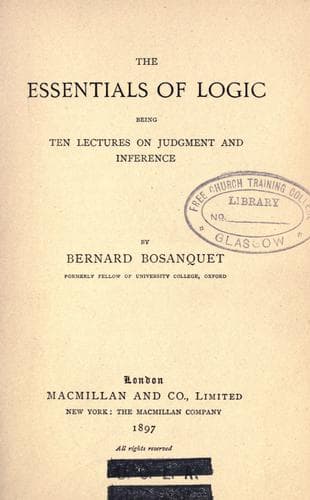
The Essentials of Logic, Being Ten Lectures on Judgment and InferenceBosanquet, Bernard
Philosophy
The Essentials of Logic, Being Ten Lectures on Judgment and Inference
Bosanquet, Bernard
Logic
Therefore the relation between content or matter of knowledge, and
the form which is its general characteristic as knowledge, is of
this kind. We can either study the objects of knowledge directly as
we perceive them, or indirectly, as examples of the way in which we
know. As studied for their own sake, they are regarded as the matter
or content in which the general form of knowledge finds individual
realisation. In botany, for instance, we have a large number of actual
plants classified and explained in their relation to one another.
A botanist is interested directly in the affinities and evolution
of these plants, and in the principles of biology which underlie
their history. He pushes his researches further and further into
the individual matters that come to light, without, as a rule, more
than a passing reflection upon the abstract nature of the methods
which he is creating as his work proceeds. He classifies, explains,
observes, experiments, theorises, generalises, to the best of his
power, solely in order to grasp and render intelligible the region of
concrete fact that lies before him. Now while his particular results
and discoveries {48} constitute the “form” or knowable properties of
the plant-world _as the object of botanical science_, the science
which inquires into the general nature of knowledge must treat these
particular results as “mere matter”--as something with which it is
not directly concerned, any more than the art which makes a statue
is primarily and directly concerned with the chemical and mechanical
properties of marble. The “form” or knowable properties with which the
general science of knowledge is directly concerned, consists in those
methods and processes which the man of science, developing the modes
in which common sense naturally works, constructs unconsciously as he
goes along. Thus, not the nature and affinities of the plant-world,
but classification, explanation, observation, experiment, theory, are
the phenomena in virtue of which the organised structure of botanical
science participates in the form of knowledge, and its objects become,
in these respects, objects of logical theory.
Hence some properties and relations of objects, being the form or
knowable structure of the concrete objects as a special department of
nature, correspond to the mere matter, stuff, or content of Knowledge
in general, while other properties and relations of objects, being
their form or knowable structure as entering into a world of reality
displayed to our intelligence, correspond to the form of Knowledge as
treated of by a general inquiry into its characteristics, which we
call Logic. It is just as the qualities or “forms” of the different
metals of which knives can be made are mere matter or irrelevant detail
when we are discussing the general “form” or quality of a good knife,
{49} whatever its material. A reservation on this head appears in the
following section.
_Form of Knowledge dependent on Content_
Public-domain text, read in full here on John Shaqi.
Reviews
Reviews
No reviews yet
Be the first to share your thoughts on this work.
Join the Discussion
Join the discussion
Sign in to leave a comment or review.
Sign InorCreate an account