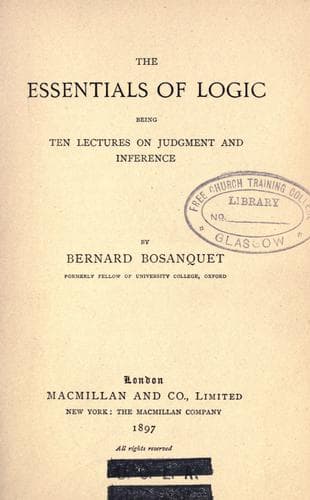
The Essentials of Logic, Being Ten Lectures on Judgment and InferenceBosanquet, Bernard
Philosophy
The Essentials of Logic, Being Ten Lectures on Judgment and Inference
Bosanquet, Bernard
Logic
2. For the form of Knowledge depends in some degree upon its matter.
It is very important to realise this truth; for if Logic is swamped
by being identified with the whole range of special sciences, it is
killed by being emptied of all adaptation to living intelligence. What
is called Formal Logic _par excellence_ in all its shapes, whether
antiquated as in Hamilton’s or Thomson’s Formal Laws of Thought,
or freshly worked out on a symbolic basis as by Boole and others,
has, it appears to me, this initial defect, _when considered as a
general theory of Logic_. As a contribution to such a theory, every
method which will work undoubtedly has its place, and indicates and
depends upon some characteristic of real thought. But in the central
theory itself, and especially in so short an account of it as must
be attempted in these lectures, I should be inclined to condemn all
attempts to employ symbols for anything more than the most passing
illustration of points in logical processes. All such attempts, I must
maintain, share with the old-fashioned laws of Identity, Contradiction,
and Excluded Middle the initial fallacy of representing a judgment
by something which is not and cannot be in any way an adequate
symbol of one. If, in order to get at the pure form of Knowledge,
we restrict ourselves to very abstract characteristics in which all
knowledge appears, very roughly speaking, to agree, and which can be
symbolized for working purposes by combinations of signs which have
not the essential properties of ideal contents, then we have _ab
initio_ substituted for the judgment something which is a very {50}
abstract corollary from the nature of judgment, and may or not for
certain purposes and within certain limits be a fair representative
of it. We cannot and must not exclude from the form of Knowledge its
modifications according to “matter,” and its nature as existing only in
“matter.”
In fact, the peculiar “form” of _everything_ depends in some degree
on its “matter.” A statue in marble is a little differently treated
if it is copied in bronze. A knife is properly made of steel; you
can only make a bad one of iron, or copper, or flint, and you cannot
make one at all of wax. Different matters will more or less take the
same form, but only within certain limits. So it is in Knowledge. The
_nature of objects as Knowledge_--for we _must_ remember that “form”
in our sense is not something put into the “matter,” something alien
or indifferent to it, but is simply its own inmost character revealed
by the structural relations in which it is found capable of standing
[1]--depends on the way in which their parts are connected together.
[1] The example of the marble statue may seem to contradict
this idea; and no doubt the indifference of matter to form is
a question of degree. But the feeling for material is a most
important element in fine art; and in knowledge there is only a
relative distinction between formal and material relations.
Public-domain text, read in full here on John Shaqi.
Reviews
Reviews
No reviews yet
Be the first to share your thoughts on this work.
Join the Discussion
Join the discussion
Sign in to leave a comment or review.
Sign InorCreate an account