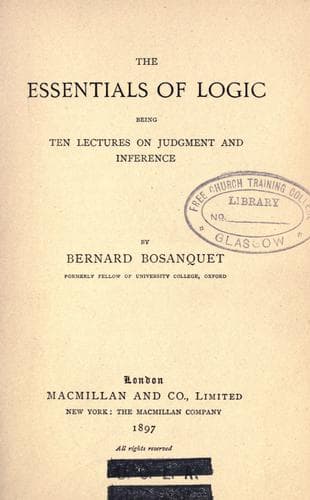
The Essentials of Logic, Being Ten Lectures on Judgment and Inference — John Shaqi
The Essentials of Logic, Being Ten Lectures on Judgment and InferenceBosanquet, Bernard
Philosophy
The Essentials of Logic, Being Ten Lectures on Judgment and Inference
Bosanquet, Bernard
Logic
Let us compare, for example, the use of number in understanding objects
of different kinds.
Suppose there are four books in a heap on the table. This heap of
books is the object. We desire to conceive it as a whole consisting
of parts. In order to do so we simply _count_ them “one, two, three,
_four_ books.” If one is taken away, there is one less to count; if
one is added, there is one more. But the books themselves, as books,
are not {51} altered by taking away one from them or adding one to
them. They are parts indifferent to each other, forming a heap which is
sufficiently analysed or synthesised by counting its parts.
But now instead of four books in a heap, let us think of the four
sides of a square. Of course we _can_ count them, as we counted the
books; but we have not conceived the nature of the square by counting
its sides. That does not distinguish it from four straight lines drawn
anyhow in space. In order to appreciate what a square is, we must
consider that the sides are _equal_ straight lines, put together in a
particular way so as to make a figure with four right angles; we must
distinguish it from a figure with four equal sides, but its angles not
right angles, and from a four-sided figure with right angles, but with
only its opposite sides equal; and note that if we shorten up one side
into nothing, the square becomes a triangle, with altogether different
properties from those of a square; if we put in another side it becomes
a pentagon, and so on.
These two things, the heap of books and the square, are _prima
facie_ objects of perception. We commonly speak of a diagram on a
blackboard or in a book as “a square” if we have reason to take it
as approximately exact, and as intended for a square. But on looking
closer, we soon see that the “matter,” or individual attributes, of
each of these objects of our apprehension demands a different form of
knowledge from that necessary to the other. The judgment “_This_ heap
of books has four books in it” is a judgment of enumerative perception.
The judgment “_The_ square has four sides” is a judgment of systematic
necessity.
{52} Why did we not keep the two judgments in the same logical shape?
Why did we say “_This_ heap” and “_The_ square”? Why did we not say
“this” in both propositions, or “the” in both propositions? Because
the different “matter” demands this difference of form. Let us try.
“The heap of books has four books in it.” Probably we interpret this
proposition to mean just the same as if we had said “This heap.” That
is owing to the fact that the judgment naturally occurs to us in its
right form. But if we interpret “The heap” on the analogy of our
interpretation of “The square,” our judgment will have become false.
It will have come to mean “Every heap of books has four books in it,”
and a judgment of perception will not bear this enlargement. The
subject is composite, and one, the most essential of its elements, is
destroyed by the change from “this” to “the.”
Public-domain text, read in full here on John Shaqi.
Reviews
Reviews
No reviews yet
Be the first to share your thoughts on this work.
Join the Discussion
Join the discussion
Sign in to leave a comment or review.
Sign InorCreate an account