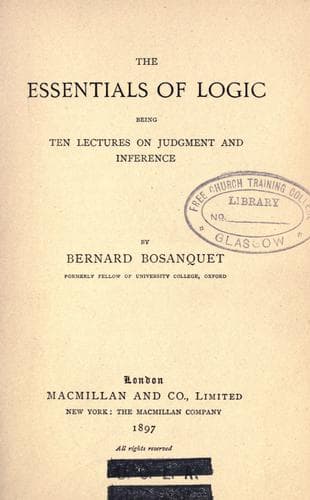
The Essentials of Logic, Being Ten Lectures on Judgment and InferenceBosanquet, Bernard
Philosophy
The Essentials of Logic, Being Ten Lectures on Judgment and Inference
Bosanquet, Bernard
Logic
Let us try again. Let us say “This square has four sides.” That is
not exactly false, but it is ridiculous. Every square must have four
sides, and by saying “this square” we strongly imply that foursidedness
is a relation of which we are aware chiefly, if not exclusively, in
the object attended to in the moment of judging, simply through the
apprehension of that moment. By this implication the form of the
judgment abandons and all but denies the character of systematic
necessity which its content naturally demands. It is like saying, “It
appears to me that in the present instance two and two make four.” The
number of sides in a square, then, is not a mere fact of perception,
while the number of books in a heap is such a fact.
But you may answer by suggesting the case that an {53} uninstructed
person--say a child, with a square figure before him, and having heard
the name square applied to figures generally resembling that figure,
may simply observe the number of sides, without knowing any of the
geometrical properties connected with it; will he not then be right in
saying, “This square has four sides”?
Certainly not. In that case he has no right to call it a square.
It would only be a name he had picked up without knowing what it
meant. All he has the right to say would be, “This object” or “This
figure has four sides.” That would be a consistent judgment of mere
perception, true as far as it went. It is always possible to apprehend
the more complex objects of knowledge in the simpler forms; but then
they are not apprehended adequately, not _as_ complex objects. It is
also possible to apply very complex forms of knowledge to very simple
objects. Most truths that can be laid down quite in the abstract about
a human mind could also be applied in some sense or other to any speck
of protoplasm, or to any pebble on the seashore. And every simple
form of knowledge is always being pushed on, by its own defects and
inconsistencies, in the direction of more complex forms.
So far I have been trying to show that objects are capable of being
different in their nature as knowledge as well as in their individual
properties; and that their different natures as knowledge depend on the
way in which their parts are connected together. We took two objects
of knowledge, and found that the mode of connection between the parts
required two quite different kinds of judgment to express them. Let us
look at the reason of this.
{54} _The relation of Part and Whole_
3. The relation of Part and Whole is a form of the relation of Identity
and Difference. Every Judgment expresses the unity of some parts in a
whole, or of some differences in an Identity. This is the meaning of
“construction” in knowledge. We saw that knowledge exists in judgment
as a construction (taking this to include maintenance) of reality.
The expression whole and parts may be used in a strict or in a lax
sense.
Public-domain text, read in full here on John Shaqi.
Reviews
Reviews
No reviews yet
Be the first to share your thoughts on this work.
Join the Discussion
Join the discussion
Sign in to leave a comment or review.
Sign InorCreate an account