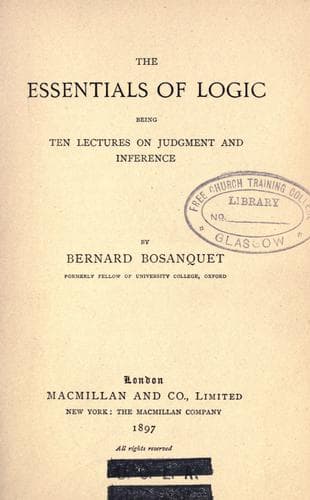
The Essentials of Logic, Being Ten Lectures on Judgment and InferenceBosanquet, Bernard
Philosophy
The Essentials of Logic, Being Ten Lectures on Judgment and Inference
Bosanquet, Bernard
Logic
In a strict sense it means a whole of quantity, that is, a whole
considered as made up by the addition of parts of the same kind, as a
foot is made up of twelve inches. In this sense the whole is the sum of
the parts. And even in this sense the whole is represented within every
part by an identity of quality that runs through them all. Otherwise
there would be nothing to earmark them as belonging to the particular
whole or kind of whole in question. Parts of length make up a whole
of length, parts of weight a whole of weight, parts of intensity a
whole of intensity, in so far as a whole of intensity is quantitative,
which is not a perfectly easy question. Wholes like these are “_Sums_”
or “_Totals_”. The relation of whole to part in this sense is a very
simple case of the relation of differences in an identity, but for
that very reason is not the easiest case to appreciate. The relation
is so simple that it is apt to pass unnoticed, and in dealing with
numerical computation we are apt to forget that in application to any
concrete problem the numbers must be numbers of something having a
common quality, and that the nature of this something may affect the
result as related to real fact, though not as a conclusion from pure
{55} numerical premisses. In a whole of pure number the indifference
of parts to whole reaches its maximum. The unit remains absolutely the
same, into whatever total of addition it may enter.
In a whole of differentiated members, such as a square, all this begins
to be different. A side in a square possesses, by the fact of being a
side, very different relations and properties from those of a straight
line conceived in isolation. In this case the whole is not made up
merely by adding the parts together. It is a geometrical whole, and its
parts are combined according to a special form of necessity which is
rooted in the nature of space. Speaking generally, the point is that
parts must occupy certain perfectly definite places as regards each
other. You cannot make a square by merely adding three right angles to
one, nor by taking a given straight line and adding three more equal
straight lines to its length. You must construct in a definite way so
as to fulfil definite conditions. The identity shows itself in the
different elements which make it up, not as a mere repeated quality,
but as a property of contributing, each part in a distinctive way, to
the nature of the whole. Such an identity is not a mere total or sum,
though I imagine that its relations can be fully expressed in terms of
quantity, certain differentiated objects or conceptions being given
(_e.g._ line and angle).
Public-domain text, read in full here on John Shaqi.
Reviews
Reviews
No reviews yet
Be the first to share your thoughts on this work.
Join the Discussion
Join the discussion
Sign in to leave a comment or review.
Sign InorCreate an account