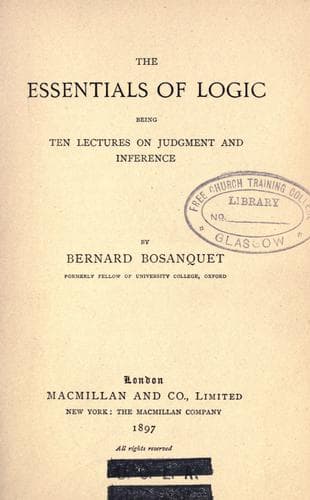
The Essentials of Logic, Being Ten Lectures on Judgment and InferenceBosanquet, Bernard
Philosophy
The Essentials of Logic, Being Ten Lectures on Judgment and Inference
Bosanquet, Bernard
Logic
I take a further instance to put a sharp point upon this distinction.
The relation of whole and parts is nowhere more perfect, short of
a living mind, than in a work of art. There is a very fine Turner
landscape now [1] in the “Old {56} Masters” Exhibition at Burlington
House--the picture of the two bridges at Walton-on-Thames. The picture
is full of detail--figures, animals, trees, and a curving river-bed.
But I am told that if one attempts to cut out the smallest appreciable
fragment of all this detail, one will find that it cannot be done
without ruining the whole effect of the picture. That means that the
individual totality is so welded together by the master’s selective
composition, that, according to Aristotle’s definition of a true
“whole,” if any part is modified or removed the total is entirely
altered, “for that of which the presence or absence makes no difference
is no true part of the whole.” [2]
[1] February 1892. [2] _Poetics_, 8
Of course, in saying that the part is thus essential to the whole, it
is implied that the whole reacts upon and transfigures the part. It is
in and by this transformation that its pervading identity makes itself
felt throughout all the elements by which it is constituted. As the
picture would be ruined if a little patch of colour were removed, so
the little patch of colour might be such as to be devoid of all value
if seen on a piece of paper by itself. I will give an extreme instance,
almost amounting to a _tour de force_, from the art of poetry, in
illustration of this principle. We constantly hear and use in daily
life the phrase, “It all comes to the same thing in the end.” Perhaps
in the very commonest speech we use it less fully, omitting the word
“thing”; but the sentence as written above is a perfectly familiar
platitude, with no special import, nor grace of sound or rhythm. Now,
in one of the closing stanzas of Browning’s poem _Any Wife to Any
Husband_, this sentence, only modified {57} by the substitution of “at”
for “in,” forms an entire line. [1] And I think it will generally be
felt that there are few more stately and pathetic passages than this
in modern poetry. Both the rhythm and sonorousness of the whole poem,
and also its burden of ideal feeling, are communicated to the line
in question by the context in which it is framed. Through the rhythm
thus prescribed to it, and through the characteristic emotion which it
contributes to reveal, the “whole” of the poem re-acts upon this part,
and confers upon it a quality which, apart from such a setting, we
should never have dreamed that it was capable of possessing.
[1] In order to remind the reader of the effect of this passage
it is necessary to quote a few lines before and after--
Public-domain text, read in full here on John Shaqi.
Reviews
Reviews
No reviews yet
Be the first to share your thoughts on this work.
Join the Discussion
Join the discussion
Sign in to leave a comment or review.
Sign InorCreate an account