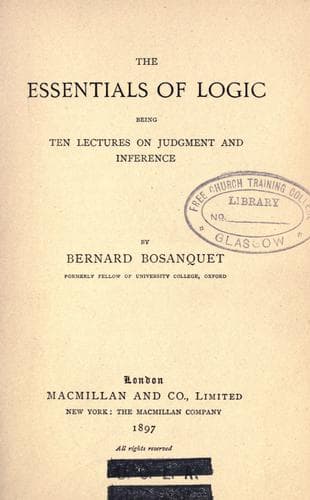
The Essentials of Logic, Being Ten Lectures on Judgment and InferenceBosanquet, Bernard
Philosophy
The Essentials of Logic, Being Ten Lectures on Judgment and Inference
Bosanquet, Bernard
Logic
“Re-issue words and looks from the old mint,
Pass them afresh, no matter whose the print,
Image and superscription once they bore!
Re-coin thyself and give it them to spend,--
It all comes to the same thing at the end,
Since mine thou wast, mine art and mine shalt be,
Faithful or faithless, sealing up the sum
Or lavish of my treasure, thou must come
Back to the heart’s place here I keep for thee!”
We are not here concerned with the peculiar “aesthetic” nature of
works of art, which makes them, although rational, nevertheless unique
individuals. I only adduced the above examples to show, in unmistakable
cases, what is actually meant when we speak of “a whole” as constituted
by a pervading identity which exhibits itself in the congruous or
co-operating nature of all the constituent parts. In wholes of a higher
kind than the whole of mere quantity the parts no longer repeat each
other. They are not merely distinct, {58} but different. Yet the common
or continuous nature shows itself within each of them.
The parts of a sum-total, taking them for convenience of summation
as equal parts, may be called units; [1] the parts of an abstract
system, such as a geometrical figure, may be called elements (I cannot
answer for mathematical usage), and the parts of a concrete system, an
aesthetic product, a mind, or a society, might be called members.
[1] A unit of measurement implies in addition that it has been
equated with some accepted standard. If I divide the length of
my room into thirty equal parts, each part is a “unit” in the
sum-total; but I have not measured the room till I have equated
one such part with a known standard, and thus made it into a
unit in the general system of length equations.
But every kind of whole is an identity, and its parts are always
differences within it.
_Nature of Knowledge_
4. It will be well to sum up here what we have learnt of the nature
of knowledge in general, before passing to the definition and
classification of Judgment.
Public-domain text, read in full here on John Shaqi.
Reviews
Reviews
No reviews yet
Be the first to share your thoughts on this work.
Join the Discussion
Join the discussion
Sign in to leave a comment or review.
Sign InorCreate an account