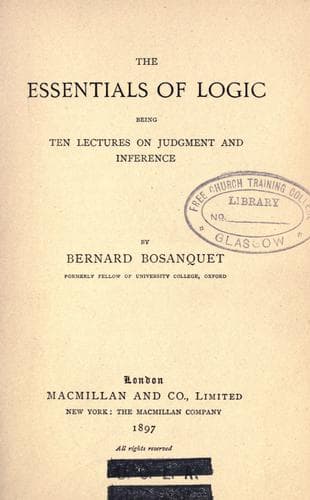
The Essentials of Logic, Being Ten Lectures on Judgment and InferenceBosanquet, Bernard
Philosophy
The Essentials of Logic, Being Ten Lectures on Judgment and Inference
Bosanquet, Bernard
Logic
First, we have to consider what is implied in claiming truth.
Secondly, by what means truth is claimed in Judgment.
{67} Thirdly, the nature of the ideas for which alone truth can be
claimed.
_What is implied in claiming truth_
(i.) Claiming truth implies the distinction between truth and falsity.
I do not say, “between truth and falsehood,” because falsehood
includes a lie, and a lie is not _prima facie_, an error or falsity of
knowledge. It is, as may be said of a question, altogether addressed
to another person, and has no existence as a distinct species within
knowledge. Thus a lie is called by Plato “falsehood in words”; the term
“falsehood in the mind” he reserves for ignorance or error, which he
treats as the worst of the two, which from an intellectual point of
view it plainly is.
No distinction between truth and falsity can exist unless, in the act
or state which claims truth, there is a reference to something outside
psychical occurrence in the course of ideas. Falsity or error are
relations that imply existences which, having reality of one kind,
claim in addition to this another kind of reality which they have not.
In fact, all things that are called false, are called so because they
claim a place or property which they do not possess. They must exist,
in order to be false. It is in the non-fulfilment, by their existence,
of some claim or pretension which it suggests, that falsity consists.
And so it is in the fulfilment of such a claim that truth has a
meaning. A false coin exists as a piece of metal; it is false because
it pretends to a place in the monetary system which its properties or
history [1] contradict.
[1] For it is, I suppose, technically false, even if over value,
if not coined by those who have the exclusive legal right to
coin.
As the claim to be true is made by every judgment in its {68} form,
there can be no judgment without some recognition of a difference
between psychical occurrences and the system of reality. That is to
say, there is no judgment unless the judging mind is more or less aware
that it is possible to have an idea which is not in accordance with
reality.
Thus, _if_ an animal has no real world distinct from his train of
mental images, if, that is, and just because, these are his world
directly, and without discord, he cannot judge. The question is, _e.g._
when he seems disappointed, whether the pleasant image [1] simply
disappears and a less pleasant image takes its place, or whether the
erroneous image was distinguished as an element in “a mere idea,” which
could be retained and compared with the systematised perceptions which
force it out, _as_ an idea with reality.
Public-domain text, read in full here on John Shaqi.
Reviews
Reviews
No reviews yet
Be the first to share your thoughts on this work.
Join the Discussion
Join the discussion
Sign in to leave a comment or review.
Sign InorCreate an account