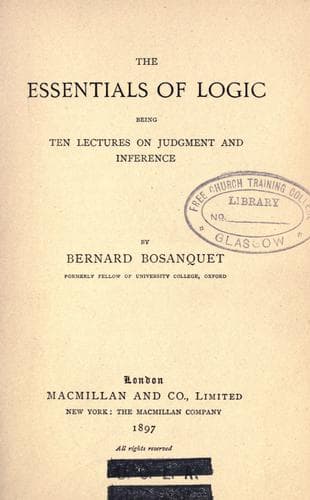
The Essentials of Logic, Being Ten Lectures on Judgment and InferenceBosanquet, Bernard
Philosophy
The Essentials of Logic, Being Ten Lectures on Judgment and Inference
Bosanquet, Bernard
Logic
[1] It will be observed that we are not treating the mental
images as being taken for such by the primitive mind. It is just
in as far as they are _not_ yet _taken for such_ that they _are
merely such_. Mr. James says that the first sensation is for the
child the universe (_Psychology_ II. 7). But it is a universe
in which all is equally mere fact, and there is no distinction
of truth and falsehood, or reality and unreality. That can only
come when an existent is found to be a fraud.
We must all of us have seen a dog show signs of pleasure when he
notices preparations for a walk, and then express the extreme of
unhappiness when the walk is not taken at all, or he is left at home.
People interpret these phenomena very carelessly. They say “he thought
that he was going to be taken out.” If he did “_think that_, etc,” then
he made a judgment. This would imply that he distinguishes between the
images suggested to his mind, and the reality of their content as the
future event of going out, and knew that he might have the one without
the other following. But of {69} course it is quite possible that the
dog has no distinct expectation of something different from his present
images, but merely derives pleasure from them, which he expresses, and
suffers and expresses pain when they are replaced by something else. It
is here, no doubt, in the conflict of suggestion and perception, that
judgment originates.
On the other hand, animals, especially domestic animals, do seem to use
the imperative, which perhaps implies that they know what they want,
and have it definitely contrasted with their present ideas as something
to be realised.
However this may be, the claim of truth marks the minimum of Judgment.
There can be no judgment until we distinguish psychical fact from the
reference to Reality. A mere mental fact as such is not true or false.
In other words, there is no judgment unless there is something that,
formally speaking, is capable of being denied. When your dog sees
you go to the front door, he may have an image of hunting a rabbit
suggested to his mind, but so far there is nothing that can be denied.
If he has the image, of course he has. There is nothing that can be
denied until the meaning of this image is treated as a further fact
beyond the image itself, in a system independent of the momentary
consciousness in his mind. _Then_ it is possible to say, “No, the
fact does not correspond to your idea,” _i.e._ what we are ultimately
obliged to think as a system is inconsistent with the idea as you
affirmed it of the same system.
_By what means the claim to truth is made_
(ii.) The first thing then in Judgment is that we must have a world of
reality distinguished from the course of our ideas. Thereupon the claim
to truth is actually made by attaching the meaning of an idea to some
point in the real {70} world. This can only be done where an identity
is recognised between reality and our meaning.
Public-domain text, read in full here on John Shaqi.
Reviews
Reviews
No reviews yet
Be the first to share your thoughts on this work.
Join the Discussion
Join the discussion
Sign in to leave a comment or review.
Sign InorCreate an account