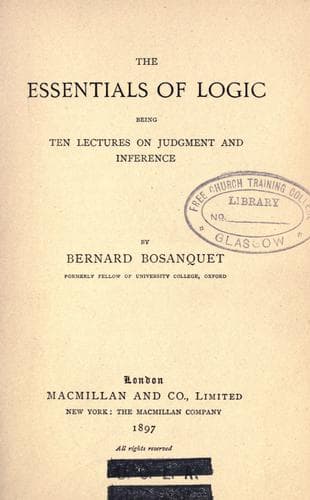
The Essentials of Logic, Being Ten Lectures on Judgment and Inference — John Shaqi
The Essentials of Logic, Being Ten Lectures on Judgment and InferenceBosanquet, Bernard
Philosophy
The Essentials of Logic, Being Ten Lectures on Judgment and Inference
Bosanquet, Bernard
Logic
Thus (keeping to the Judgment of Perception) I say, “This table is
made of oak.” This table is given in perception already qualified by
numberless judgments; it is a point in the continuous system or tissue
which we take as reality. Among its qualities it has a certain grain
and colour in the wood. I know the colour and grain of oak-wood, and if
they are the same as those of the table, then the meaning or content
“made of oak” coalesces with this point in reality, and instead of
merely saying, “This table is made of wood that has such and such a
grain and colour,” I am able to say “This table is made of oak-wood.”
This example shows the true distinction between the Logical Subject and
Predicate. The fact is, that the ultimate subject in Judgment is always
Reality. Of course the logical subject may be quite different from
the grammatical subject. Some kinds of words cannot in strict grammar
be made subjects of a sentence, though they can represent a logical
subject quite well: _e.g._ “_Now_ is the time.” “_Here_ is the right
place_.” Adverbs, I suppose, cannot be grammatical subjects. But in
these sentences they stand for the logical subjects, certain points in
the perceptive series.
The true logical subject then is always reality, however much disguised
by qualifications or conditions. The logical predicate is always
the meaning of an idea; and the claim to be true consists in the
affirmation of the meaning as belonging to the tissue of reality at
the point indicated by the subject. The connection is always made by
identity of {71} content at the point where the idea joins the reality,
so that _the judgment always appears as a revelation of something which
is in reality_. It simply develops, accents, or gives accuracy to a
recognised quality of the real. This is easily seen in cases of simple
quality--_e.g._ “This colour is sky-blue.” The colour is given, and the
judgment merely identifies it with sky-blue, and so reveals another
element belonging to its identity, the element of being seen in the sky
on a clear day.
The analysis is not quite so easy when there is a concrete subject like
a person; for how can there be an identity between a person and a fact?
“A.B. passed me in the street this afternoon.” Between what elements is
the identity in this case? It is between him, as an individual whom I
know by sight in other places, and him as he appeared this afternoon in
particular surroundings. His identity already extends through a great
many different particulars of time and place, and this judgment merely
recognises one more particular as included in the same continuous
history. “He in this context belongs to him in a former context.” In
this simple case the operative identity is probably that of my friend’s
personal appearance; but the judgment is not merely about that but
about his whole personality, of which his personal appearance is merely
taken as a sign.
Public-domain text, read in full here on John Shaqi.
Reviews
Reviews
No reviews yet
Be the first to share your thoughts on this work.
Join the Discussion
Join the discussion
Sign in to leave a comment or review.
Sign InorCreate an account