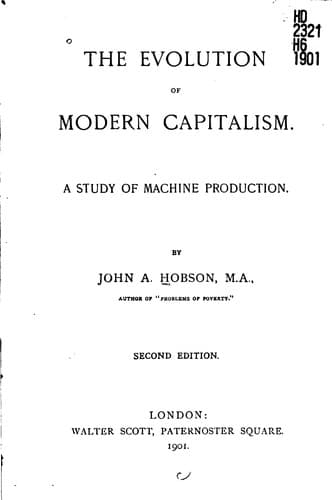
The Evolution of Modern Capitalism: A Study of Machine ProductionHobson, J. A. (John Atkinson)
History
The Evolution of Modern Capitalism: A Study of Machine Production
Hobson, J. A. (John Atkinson)
Capitalism; Industries -- History; Machinery in the workplace
The simplest structure of "domestic" manufacture is that in which the
farmer-manufacturer is found purchasing his own material, the raw wool
or flax if he is a spinner, the warp and weft if he is a weaver, and,
working with his family, produces yarn or cloth which he sells
himself, either in the local market or to regular master-clothiers or
merchants. The mixed cotton weaving trade was in this condition in the
earlier years of the eighteenth century. "The workshop of the weaver
was a rural cottage, from which, when he was tired of sedentary
labour, he could sally forth into his little garden, and with the
spade or the hoe tend its culinary productions. The cotton-wool which
was to form his weft was picked clean by the fingers of his younger
children, and was carded and spun by the older girls assisted by his
wife, and the yarn was woven by himself assisted by his sons."[43]
Following as the central point the ownership of the requisites of
production, we find in the next stage that the ownership of the
material has passed from the workman into the hands of the organising
merchant or middleman, who usurps the title "manufacturer." The
workman, however, still retains the ownership of the implements of his
craft and works in his own house. The condition of the worsted trade
later in the century, about 1770, well illustrates this industrial
form.
"The work was entirely domestic, and its different branches widely
scattered over the country. First, the manufacturer had to travel on
horseback to purchase his raw material among the farmers, or at the
great fairs held in those old towns that had formerly been the
exclusive markets, or, as they were called, 'staples' of wool. The
wool, safely received, was handed over to the sorters, who rigorously
applied their gauge of required length of staple and mercilessly
chopped off by shears or hatchet what did not reach the standard as
wool fit for the clothing trade. The long wool thus passed into the
hands of the combers, and, having been brought back to them into the
combed state, was again carefully packed and strapped on the back of
the sturdy horse, to be taken into the country to be spun.... Here, at
each village, he had his agents, who received the wool, distributed it
amongst the peasantry and received it back as yarn. The machine
employed was still the old one-thread wheel, and in summer weather on
many a village green might be seen the housewives plying their busy
trade, and furnishing to the poet the vision of contentment spinning
at the cottage door. Returning in safety with his yarn, the
manufacturer had now to seek out his weavers, who ultimately delivered
to him his camblets or russels, or tammies or calimancoes (such were
the leading names of the fibres) ready for sale to the merchant or
delivery to the dyer."[44]
Public-domain text, read in full here on John Shaqi.
Reviews
Reviews
No reviews yet
Be the first to share your thoughts on this work.
Join the Discussion
Join the discussion
Sign in to leave a comment or review.
Sign InorCreate an account