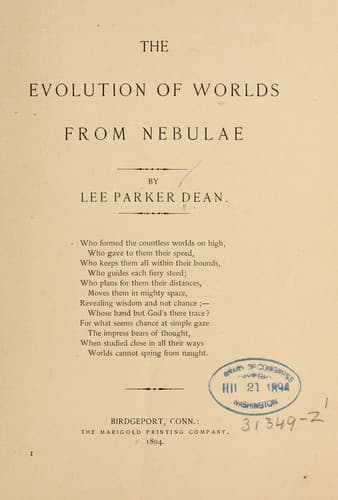
The evolution of worlds from nebulaeDean, Lee Parker
Science
The evolution of worlds from nebulae
Dean, Lee Parker
Nebular hypothesis
If the nebular theory will sufficiently account for the throwing-off
and cooling of the planets, will it likewise account for the millions
of suns disseminated throughout space? In the first place, let us
suppose that all these suns were made at the same time and filled space
with the same substance as our earth, only in a diffused state. In
such a case I cannot conceive how it could break up and resolve into
stars, for there being no space to turn in all would revolve together.
The pulp within the rind of an orange could not be cut into circles and
caused to revolve inside of that rind; so fire-mist once filling the
immensity of space must have continued to revolve in an unbroken mass.
Secondly; If the stars were formed at different periods of time should
not many be still forming? whereas space appears wondrously clear. We
would think if all this great space were to-day filled with nebulae
composed of material similar to that of earth, we could not see; for
our vision of the heavens would be obstructed thereby, and we should
know nothing about the countless numbers of stars that, with the aid of
the telescope, now make the very heavens to blaze with light. Why is it
that the space about all, or nearly all, of the suns has thus cleared
if a state of fire-mist is common to all of them? It is true Nebulae
are seen that appear like vast fields of dim light, but they are often
resolved into stars when examined with powerful instruments, and the
nebulae that cannot be thus resolved into suns occupy but a small
portion of the heavens. Less than one cubic foot is now left out of the
147,200 millions of cubic feet in every cubic mile of fire-mist that
the sun’s sphere must have contained when it reached out to the planet
Neptune, and what has become of it all? If it is not in our system
it must have gone into others. Again; if among the stars that we now
see there are a million, or even a thousand times as many dark bodies
as luminous ones, they must in a measure obstruct the light of the
glowing suns. But were this known to be true it would not prove that
these bodies were not originally formed dark objects; and who but an
omnipotent and omniscient Ruler could prevent repeated collisions among
them?
The nebular theory accounts only for our own solar system, and yet all
the stars that we see in the heavens can be no less wondrous than our
own flaming sun. That we see their light even, at so great a distance,
is proof that they can be no less great. We must account, then, not
only for our own planetary system, but for the countless millions
that exist; and we must concede that the laws that govern one would,
presumably, govern every one. Hence, a period of fire-mist for one
implies the same for all.
Public-domain text, read in full here on John Shaqi.
Reviews
Reviews
No reviews yet
Be the first to share your thoughts on this work.
Join the Discussion
Join the discussion
Sign in to leave a comment or review.
Sign InorCreate an account