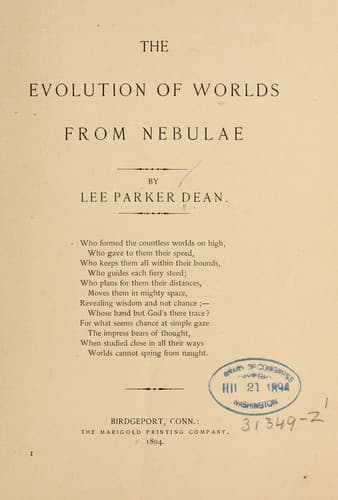
The evolution of worlds from nebulaeDean, Lee Parker
Science
The evolution of worlds from nebulae
Dean, Lee Parker
Nebular hypothesis
Finally, as space thus surpasses everything in its greatness excepting
its Creator, let us contemplate it once again in the following manner.
Suppose we could create 40,000 millions of cubic miles of ether daily;
we would at the end of the week have an amount equalling the volume
of our earth. If we continued that creation daily,—not for hundreds,
thousands, or millions of years even,—but for 1,000 millions of
millions of years, we should then have as many such volumes of ether
the size of earth as there are drops of water in one cubic mile. But
what of all this? Admitting that we could create bodies as fast as our
earth was made, and continue to do so for 1,000 millions of millions
of years, it would still be of little account; for its insignificance
is seen when we remember it is but one-fifty-eight thousand millionth
part of what a sphere would contain with a radius of one year’s flight
of light. To think of 40,000 millions of cubic miles being created
daily, with the process continued for 1,000 millions of millions of
years, and _that_ vast quantity still further expanded 58,000 millions
of times, would seem the extent of greatness itself and beyond all
human realization. Yet we can still say all this would be of slight
consequence, for it represents a sphere whose radius is but one year
of light’s flight, and that sphere compared to one of 1,000 millions
of years radius is no more than a boy’s marble,—with a radius of but
one-fourth of an inch,—to earth whose radius is 4,000 miles, and a
thousand million times larger than the radius of the marble.
We have endeavored by the above comparisons to show the vastness of
space; and although our efforts must be in vain because of our inability
to comprehend such great figures, still it is pleasant to contemplate
this ether, upon which time has so little effect, because man is mortal
and the 1500 millions of people that pass from earth every 33 years
makes it seem to him that death reigns everywhere. But when we consider
that the only things essentially effected by time are the animal and
vegetable kingdom, and that all men now living could occupy about
one-fifteenth of one cubic mile of earth; we see that death, even in
the animal kingdom, is confined to a few cubic miles, and to but a few
more in the vegetable kingdom. The inconceivable millions of millions
of cubic miles in a sphere with a radius of one million years of
light’s flight is in no manner affected, as we perceive, by the dread
power that we recognize in the dissolution of mortal bodies.
Public-domain text, read in full here on John Shaqi.
Reviews
Reviews
No reviews yet
Be the first to share your thoughts on this work.
Join the Discussion
Join the discussion
Sign in to leave a comment or review.
Sign InorCreate an account