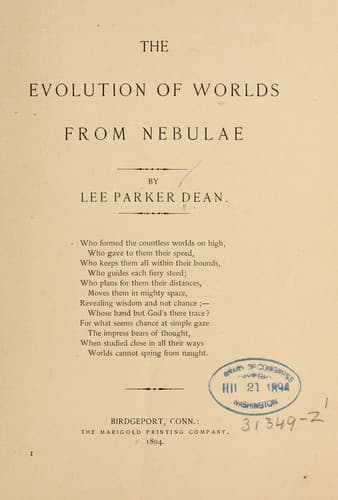
The evolution of worlds from nebulaeDean, Lee Parker
Science
The evolution of worlds from nebulae
Dean, Lee Parker
Nebular hypothesis
According to this theory,—if all the planets are of the same substance
as the earth on which we live, and of the greater sun from which they
have ages since been separated,—there must once have been material
heavy as rock and earth after condensation, filling the space around
our sun in every direction for 3,000 millions of miles. If we could
learn _how_ this material of fire-mist originated we could better
understand the mystery of world-making. A theory that would explain the
formation of our own solar system should explain the formation of all
the suns in space, a state of fire-mist for one implying the same for
all. Let us consider whether there may not be other explanations of the
phenomena in question fully as credible as the one given, and quite as
consistent with all the known laws of nature.
CHAPTER I.
EXPANSION AND CONTRACTION.
1st. _Expansion._ It is supposed by the nebular hypothesis that the
planets were all formed from rings of condensing vapor thrown off from
a contracting sun which once filled space to, and beyond, Neptune’s
distance. Let us imagine them again expanded to a like dimension,
or even greater, reaching half way to the next nearest sun, Alpha
Centauri, whose distance from our sun is computed as about twenty
trillions of miles. Assuming this to be the true distance there could
be placed between the two stars fifteen septillions of suns, each with
a diameter of 800 thousand miles. Were it possible to expand the earth
a million and a quarter times its present size, that is as large as
the sun now is, it would then be but one fifteen-septillionth the size
necessary to fill the space between the sun and Alpha Centauri. What
we know of earth, air, water, rocks, and the metals would not lead us
to suppose that these substances could be increased by expansion even
a million of times. Could there be such an expansion they would then
exist as mere atomic particles of dust incapable of holding heat with
the outside element space 300° below zero. Nearly all known substances
expand on being heated, though not often to any great extent; as,
for example, iron and the metals. But anything that is greatly
expanded cools rapidly. Then may we suppose that earth to-day could be
expanded into a body large enough to fill the great space it must once
have occupied in the state of fire-mist claimed for it? or, if thus
expanded, that it would take one year, or even one day, to cool such a
body?
Public-domain text, read in full here on John Shaqi.
Reviews
Reviews
No reviews yet
Be the first to share your thoughts on this work.
Join the Discussion
Join the discussion
Sign in to leave a comment or review.
Sign InorCreate an account