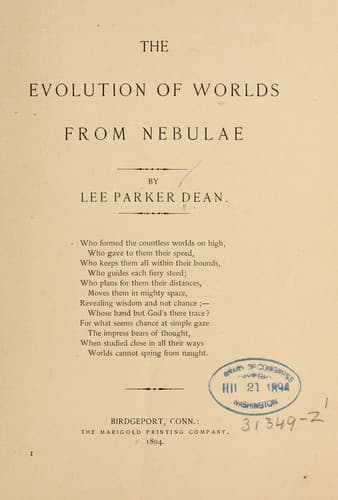
The evolution of worlds from nebulaeDean, Lee Parker
Science
The evolution of worlds from nebulae
Dean, Lee Parker
Nebular hypothesis
Even these bodies, as we understand, are changed only in the
combination of molecules, and by that change the immortal spirit,
that is as imperceptible as the wind, of which we are told we cannot
tell “whence it cometh nor whither it goeth,” is set free; the Bible
teaching us its eternal destiny. The greatest and best things that men
here possess are love and goodness, and should not the Almighty possess
these virtues beyond any of His creatures? Possessing these how could
He otherwise than send to Earth His Son for their salvation from sin;
for we find men here, even, who are willing to peril their lives for
the salvation of their fellows, and would undoubtedly be kind to an
inferior animal, though an ant or worm, had they created it and knew it
loved and worshiped them. Akin to this, we believe, is man’s relation
to his Creator and the Creator of this mighty and seemingly everlasting
Space.
[Illustration: Decoration]
FOOTNOTES:
[10] For example: Take two rooms and heat one as hot as the sun now is
what must the cold in the next room be to equalize the heat to 300°
below zero?
[11] We do not inquire how the original nebula came into being; our
history must commence with the actual existence of this nebula. There
is, let it be confessed, a great deal of obscurity still clinging to
the subject. Though we may be sure, that the great nebula once existed
we cannot with much confidence trace out the method by which the
planets were actually formed.
Sir Robert Ball, “In Starry Realms,” p. 348.
CHAPTER V.
THE EARTH’S CRUST.
Were earth’s crust no thicker in comparison than the skin of an apple
or peach, or 1/100 of its radius even, still man has never penetrated
to one-twentieth of that depth; for I know of no place where he has
as yet reached one mile below earth’s general level, unless it be in
ocean-soundings. In most places the mines or gorges have been in the
mountains high above the valleys, consequently we know little of what
is far beneath the earth’s surface. How could we judge of the inside
of nuts, fruits, grains, or vegetables if we had penetrated to but
one-twentieth of their coverings?
Take, for instance, a chestnut that all boys are familiar with, and see
what we may learn from it. We find that it is covered with a tough,
brown shell which in turn is enclosed in a large prickly burr ten times
the size of the nut. This protects it until ripened and then opens to
let the nut fall. The burr is fastened to a large forest tree whose
roots are deep in the ground; a tree that had been growing for years
before the chestnut was produced, and first started from another nut
of its kind. From the time its growth began there was nothing in root,
trunk, limb, or leaves for years that in any way resembled a chestnut;
nor in the blossom or burr even, until the nut ripened and fell to the
ground. Could one think, who had never before seen the nut, that from
such a tree a chestnut could be produced?
Public-domain text, read in full here on John Shaqi.
Reviews
Reviews
No reviews yet
Be the first to share your thoughts on this work.
Join the Discussion
Join the discussion
Sign in to leave a comment or review.
Sign InorCreate an account