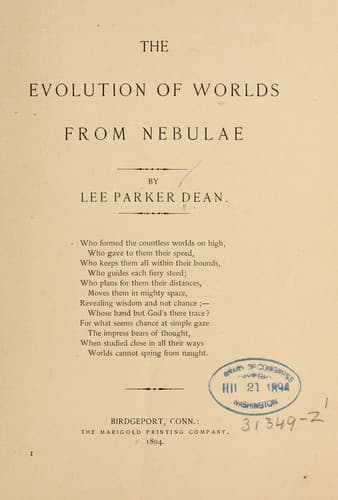
The evolution of worlds from nebulaeDean, Lee Parker
Science
The evolution of worlds from nebulae
Dean, Lee Parker
Nebular hypothesis
The same is true of all manner of nuts, fruits, and vegetables. It is
even true of animals, for they are enclosed in such varied coverings
that their nature is often quite concealed from us. We may as well
believe there is something in earth’s interior, away from winds and
cold, as precious over and above its crust as the chestnut is better
than the burr that encloses it; the fruit better than its rind; or
fish, birds, and animals better than their skins. Knowing this, man,
while he would grasp the greatness of the universe, may somewhat
under-rate the contents of his own earth.
Dr. Winchell in speaking of cold has said; “It has been demonstrated
that an ice-cap resting several thousand years over any considerable
portion of the surface would so reduce the subjacent temperature of
the earth that for many centuries after the disappearance of the ice,
a decrease of temperature would be discovered in penetrating downward.
Even centuries later, so much cold would still remain within the earth,
that the rate of increase of temperature would be less than if the
ice-cap had not existed; and after 3,600 years, that rate would be only
half the normal rate.”[12]
Now if the earth’s crust will thus retain the cold why may it not as
well retain the heat? In that case any excess of heat escaping from
earth, over and above the heat it constantly receives from the sun,
may be readily accounted for. It is claimed that the earth has large
quantities of sunlight and heat stored in a liquid state, as petroleum;
in a gaseous state, as natural gas; and in a solidified form, as coal;
some of which are found at a depth of 1600 or more feet, although coal
is sometimes found near the surface, and even upon the mountains. If
these are all stored sunlight, why do they not accumulate over earth’s
entire surface as well as in certain localities,—especially in the
torrid zone where great heat exists,—and accumulate to-day as well as
in former ages?
Public-domain text, read in full here on John Shaqi.
Reviews
Reviews
No reviews yet
Be the first to share your thoughts on this work.
Join the Discussion
Join the discussion
Sign in to leave a comment or review.
Sign InorCreate an account