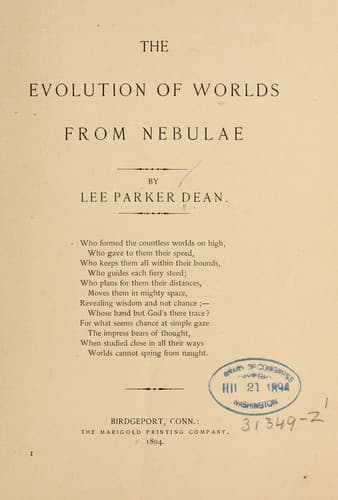
The evolution of worlds from nebulaeDean, Lee Parker
Science
The evolution of worlds from nebulae
Dean, Lee Parker
Nebular hypothesis
We have seen thus how improbable it is that the earth could be expanded
to fill the space it must once have occupied according to the nebular
theory; and as we imagine the denser any volume is the more it will
expand can we suppose the other planets, with a volume thousands of
times greater than that of earth but a density not averaging one-fourth
as much, will expand to a greater degree? Were they all ground to the
finest dust, even like the atoms we detect floating in the sunbeams,
they would no more than fill a globe, with the sun for its centre,
whose circumference reached out to Neptune.
2d. _Contraction._ It is thought by many that the sun obtains its heat
by the contraction of its diameter, and that at the rate of two hundred
and twenty feet per year, or four miles a century. Before contraction,
then, both the sun and the earth must have been much larger and
consequently nearer each other than they are as seen to-day. If the
sun’s diameter contracts four miles during a century, to increase its
size so as to carry it out to Neptune, 3,000 millions of miles distant,
would take 1500 million centuries. But that the sun thus receives its
heat is a supposition; for how can any one tell that it contracts
each century two miles on its radius, when a second represents four
hundred and fifty miles, and two miles would be but one-two hundred and
fiftieth part of a second?
Should the earth be cooling by expending more heat than it receives,
as some claim, it should contract from the loss of heat as well as the
sun. But if earth does thus contract it must be smaller than formerly,
the sun must have less hold upon it, and with a varying gravitation,
must lose its delicate balance.[2] Yet what proof have we that earth is
to-day smaller than it was two thousand years ago?
Further, we find that the more a body contracts the faster it revolves.
The sun now revolves in twenty-five days, but when eight million times
larger and extended out as far as earth, it must have revolved very
slowly; hence with a slow revolution, and at the same time having only
four cubic rods of hard substance out of every thirty-three millions
of cubic rods, or one cubic mile,—for earth has contracted to one
eight-millionth part of the size it then was,—why did not the rocky
substance settle to the sun’s centre instead of being thrown off to
form earth, especially as the sun’s gravitation was so great at its
surface?
Public-domain text, read in full here on John Shaqi.
Reviews
Reviews
No reviews yet
Be the first to share your thoughts on this work.
Join the Discussion
Join the discussion
Sign in to leave a comment or review.
Sign InorCreate an account