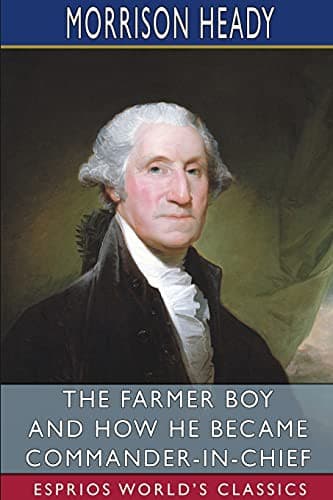
The Farmer Boy, and How He Became Commander-In-ChiefHeady, Morrison
History
The Farmer Boy, and How He Became Commander-In-Chief
Heady, Morrison
Washington, George, 1732-1799
For the five years following his father's death, George made his home
at the house of his half-brother, Augustine Washington, at a
considerable distance from his mother's, where he might have the
benefit of a better school which that neighborhood afforded. His new
schoolmaster was a Mr. Williams, a very worthy man; who, however,
although he knew a vast deal more than Mr. Hobby, the poor old
grave-digger, was far from being what we might call a first-rate
scholar. But what his teacher lacked in learning, George made up in
diligence, and the most judicious use of every means of
self-improvement within his reach. And here, my dear children, let me
remind you of a thing worthy of your remembrance through life, that
success in the pursuit of knowledge depends far less upon the ability
and skill of the teacher, than upon the industry, perseverance, and
willing application of the learner.
Under the instruction of this, his second and last teacher, George got
a little insight into English grammar, read some history, became well
acquainted with geography, completely mastered arithmetic, and made
handsome progress in geometry and trigonometry; which, as you must
know, are higher branches of mathematics than arithmetic, and far more
difficult to comprehend. In connection with the two latter, he studied
surveying; by which is taught, as you must continue to bear in mind
hereafter, the measurement of land.
When he had advanced so far in this study as to give him some idea of
the proper use and handling of the chain and compass, the two
principal instruments employed in this art, he began to put his
knowledge into practice by taking surveys of the farms lying in the
immediate neighborhood of his schoolhouse, and also of the lands
belonging to the estate of Mount Vernon.
Assisted by his schoolmates, he would follow up, and measure off with
the help of his long steel chain, the boundary lines between the
farms, such as fences, roads, and watercourses; then those dividing
the different parts of the same farm; determining at the same time,
with the help of his compass, their various courses, their crooks and
windings, and the angles formed at their points of meeting or
intersection. This would enable him to get at the shape and size not
only of each farm, but of every meadow, field, and wood composing it.
This done, he would make a map or drawing on paper of the land
surveyed, whereon would be clearly traced the lines dividing the
different parts, with the name and number of acres of each attached;
while, on the opposite page, he would write down the long and
difficult tables of figures by which these results had been reached.
All this he would execute with as much neatness and accuracy as if it
had been left with him to decide thereby some gravely disputed
land-claim.
Public-domain text, read in full here on John Shaqi.
Reviews
Reviews
No reviews yet
Be the first to share your thoughts on this work.
Join the Discussion
Join the discussion
Sign in to leave a comment or review.
Sign InorCreate an account