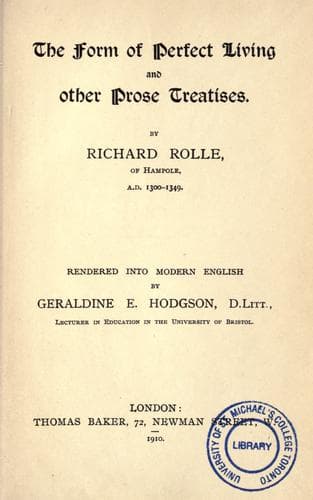
The Form of Perfect Living and Other Prose TreatisesRolle, Richard, of Hampole
Religion
The Form of Perfect Living and Other Prose Treatises
Rolle, Richard, of Hampole
Christian life; Rolle, Richard, of Hampole, 1290?-1349
There is, among his voluminous writings, a curious and interesting
_Revelation concerning Purgatory_, purporting to be a woman's dream
about one, Margaret, a soul in Purgatory. Amidst much natural horror,
not however exceeding that described by Dante, there are many quaint
side-lights thrown upon our forefathers' ways of thought; as _e.g._,
when Margaret's soul is weighed in one scale, against the fiend, "and a
great long worm with him," in the other; the worm of conscience, in
fact. But the work has not been included in this volume, lest it should
prove wholly unprofitable to a generation which if it be not readily
disturbed by sin, is easily and quickly shocked by crude suggestions
concerning its possible consequences and reward. They will find enough,
perhaps, in the treatise _on Daily Work_.
If any one should think that there, and in one portion of the treatise
_on Grace_, Rolle has dwelt harshly on considerations of fear, rather
than on those of love, he must not make the mistake of concluding that
these admonitions represent the whole of Catholic teaching on the point.
Men's temperaments differ, and teachers, meeting these various tempers,
differ in their modes of helping them. Side by side with Richard Rolle
may be put the words of S. Francis Xavier, in what is perhaps the most
beautiful of Christian hymns:--
My GOD, I love Thee; not because
I hope for heaven thereby,
Nor yet because who love Thee not
Are lost eternally.
. . . . . .
Not for the hope of gaining aught,
Not seeking a reward;
But as Thyself hast loved me,
O ever-loving Lord!
Moreover, no reader of the Epistle _on Charity_ can entertain any doubt
as to whether our English Mystic understood the mystery of limitless
love.
It is no doubt, easy to complain, as we read certain passages, that
Richard Rolle's recommendations are neither new nor original: but if
instead of dismissing them as familiar, we tried to put them into
practice, we should perhaps have less leisure for idle criticism of
others, and ourselves be less evil and tiresome people.
Public-domain text, read in full here on John Shaqi.
Reviews
Reviews
No reviews yet
Be the first to share your thoughts on this work.
Join the Discussion
Join the discussion
Sign in to leave a comment or review.
Sign InorCreate an account