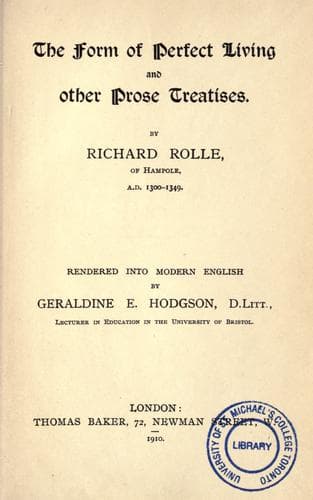
The Form of Perfect Living and Other Prose TreatisesRolle, Richard, of Hampole
Religion
The Form of Perfect Living and Other Prose Treatises
Rolle, Richard, of Hampole
Christian life; Rolle, Richard, of Hampole, 1290?-1349
On the other hand, the accusation may be brought that he proposes an
impossibly high aim. No doubt, in such a pitch of devotion as is
suggested, _e.g._, in ch. viii. of _The Form of Perfect Living_, some
may think they find extravagance: but no doubt it was this same spirit
which inspired SS. Peter and Paul, and the other Apostles; which built
up the Early Church; which made Saints, Martyrs and Confessors; which
suggested such apparently forlorn hopes as that of S. Augustine of
Canterbury, when, to bring them the Gospel of JESUS Christ, he bearded
the rough Men of Kent, and (according to Robert of Brunne) reaped, as
his immediate reward, a string of fishtails hung on his habit, though
later, the conversion of these sturdy pagans. It was doubtless, too, the
spirit which inspired the best men and women in the English Church,
before they began to confuse the spheres of Faith and Reason, and to
disregard S. Hilary's warning about the difficulty of expressing in
human language that which is truly "incomprehensible,"--incomprehensible
in the old sense, as in the Athanasian Symbol, "Immensus Pater, immensus
Filius, immensus Spiritus sanctus"; till, indeed, men forgot, for all
practical purposes that infinity transcends the grasp of finite minds
(in fact, as well as in placidly accepted and then immediately neglected
theory); and can be apprehended only, and that imperfectly, by the best
aspirations of a heart, set of fixed purpose on that high goal.
To the modern Englishman, immersed in business anxieties, imperial
interests and domestic cares, the invitation repeated so often by
Richard Rolle, to love GOD supremely, may seem incalculably unreal and
remote, even though he might hesitate to confess it baldly. But what if
the Englishman who so loved GOD, were also the greater Englishman? And
what answer does history return to that plain question?
Public-domain text, read in full here on John Shaqi.
Reviews
Reviews
No reviews yet
Be the first to share your thoughts on this work.
Join the Discussion
Join the discussion
Sign in to leave a comment or review.
Sign InorCreate an account