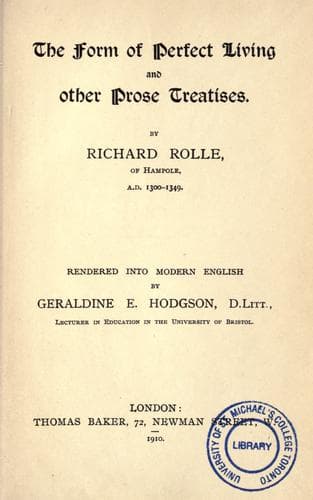
The Form of Perfect Living and Other Prose TreatisesRolle, Richard, of Hampole
Religion
The Form of Perfect Living and Other Prose Treatises
Rolle, Richard, of Hampole
Christian life; Rolle, Richard, of Hampole, 1290?-1349
"Richard Rolle," Professor Horstman does not hesitate to write "was one
of the most remarkable men of his time, yea, of history. It is a strange
and not very creditable fact that one of the greatest of Englishmen has
hitherto been doomed to oblivion. In other cases, the human beast first
crucifies, and then glorifies or deifies the nobler minds, who swayed by
the Spirit, do not live as others live, in quest of higher ideals by
which to benefit the race; he, one of the noblest champions of humanity,
a hero, a saint, a martyr in this cause has never had his resurrection
yet--a forgotten brave. And yet, he has rendered greater service to his
country, and to the world at large, than all the great names of his
time. He rediscovered Love, the principle of Christ. He reinstalled
feeling, the spring of life which had been obliterated in the reign of
scholasticism. He re-opened the inner eye of man, teaching contemplation
in solitude, an unworldly life in abnegation, in chastity, in
charity.... He broke the hard crust that had gathered round the heart of
Christianity, by formalism and exteriority, and restored the free flow
of spiritual life."
This passage, to those who feel that there has been no age since the
Birth of Christ when the great principles of religious life have been
wholly lost, and who remember that Richard Rolle lived in the age of
Dante, may seem overstated. But it shews sufficiently at least, and for
that reason is quoted here, what a great Englishman he was, and what a
debt his unaware countrymen owe him; a debt which they could pay in the
way most grateful to him, by listening to his words.
It may be remarked, by the way, that Rolle is not inclined to substitute
individualism for the authority of the Church; a change which has been
brought against some mystics. There is immense emphasis laid, all
through his writings, on the importance of conduct. The penetrating
analysis, in ch. vi, of _The Form of Perfect Living_, of the possible
sins humanity can commit on its journey through the wilderness of this
world, hardly leaves a corner of the heart unlighted; lets not one
possible shift, twist or excuse of the human conscience go free. But it
all has the Church as its immediate background; the Mystical _Body_, not
the individual soul in isolation, is everywhere taken for granted. Man
lives not to himself nor dies to himself, even though he be Richard
Rolle the hermit, or Margaret Kirkby the recluse, that is the plain
teaching of these plain-speaking pages. And all through them too is a
tough common sense, and an unusually alert power of observation; and
there is perhaps an element of that business capacity, which some of the
Saints and Mystics have shewn, in his inclusion among "sins of deed" of
"beginning a thing that is above our might"; for in that there is not
only pride, but a kind of stupid incapacity surely.
Public-domain text, read in full here on John Shaqi.
Reviews
Reviews
No reviews yet
Be the first to share your thoughts on this work.
Join the Discussion
Join the discussion
Sign in to leave a comment or review.
Sign InorCreate an account