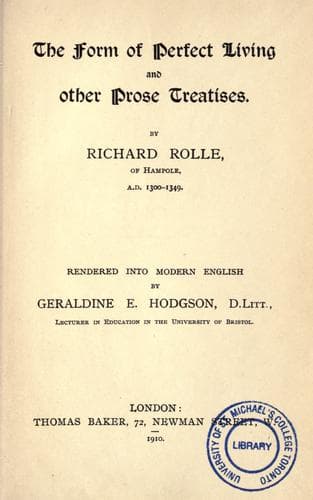
The Form of Perfect Living and Other Prose Treatises — John Shaqi
The Form of Perfect Living and Other Prose TreatisesRolle, Richard, of Hampole
Religion
The Form of Perfect Living and Other Prose Treatises
Rolle, Richard, of Hampole
Christian life; Rolle, Richard, of Hampole, 1290?-1349
It is quite possible that Rolle's tendency to repetition may tire any
one who reads him "straight on," as the phrase is. But it is doubtful
whether that be the best means of approach. If he be read in bits, he
will prove far more effective: and his ability to hit the right nail on
the head, and to hit it wonderfully hard, may occasionally bring his
words home to our immediate circumstances with an appositeness that may
be more than a coincidence.
In the past, the learned and ignorant alike have been guilty of the
operation which may be described as cutting man up into parts: _i.e._,
they have been inclined to treat him now as if he were all intellect,
then as if he were all feeling; while to the will a kind of intermediate
part has generally been allotted, as if it were the handmaid instead of
the master of the other two. And there is still, in some quarters, a
tendency to relegate the will and the feelings to an inferior plane, if
indeed they be allowed any place at all. In other quarters, the
onslaught is made on intellect. Men are bidden to be humble, to become
as little children; as if there were any humility in thinking
incorrectly or not at all; as if the odd, though suppressed, assumption
that children have no intellects had any ground in fact. It is surely a
true apostrophe--
"GOD! Thou art mind! Unto the master-mind,
Mind should be precious."
The Angelic Doctor himself paid a tribute to the importance and special
difficulties of intellect, and also to the necessity of uniting it with
will:--"the martyrs had greater merit in faith, not receding from the
faith for persecutions; and likewise men of learning have greater merit
of faith, not[1] receding from the faith for the reasons of philosophers
or heretics alleged against it." Richard Rolle, following on the same
lines as S. Thomas Aquinas, has nothing of this spirit of division: the
whole being is what he would fain see offered to GOD, whether it be so
by Margaret Kirkby, or by those who are "in the world," for whom _Our
Daily Work_ was written. In the image of GOD was man made, and therefore
GOD suffices for all the needs of man's nature: that, at least seems to
be the underlying idea when Rolle writes:--"GOD is light and burning.
Light clarifies our reason, burning kindles our will." May we not say
here too?--"What GOD has joined together, that let not man put asunder."
Public-domain text, read in full here on John Shaqi.
Reviews
Reviews
No reviews yet
Be the first to share your thoughts on this work.
Join the Discussion
Join the discussion
Sign in to leave a comment or review.
Sign InorCreate an account