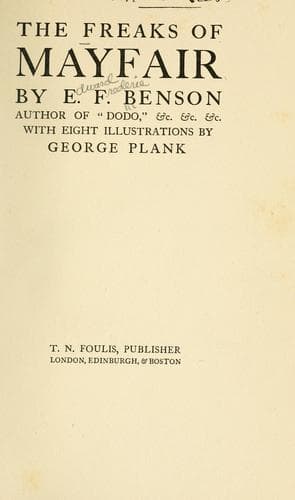
The Freaks of MayfairBenson, E. F. (Edward Frederic)
General
The Freaks of Mayfair
Benson, E. F. (Edward Frederic)
England -- Social life and customs -- 20th century -- Fiction; Humorous stories, English; Short stories, English
_Le Roi est mort: Vive le Roi_: Captain Lord Whittlemere took the reins
of government into his feudal grasp, and his mother with four rows of
pearls for her life, two carriages and a pair of carriage horses and a
jointure of £6000 a year entered into the most characteristic phase of
her existence. She was fifty-six years old, and since she proposed to
live till at least eighty, she bought the lease of a great
chocolate-coloured house in Mayfair with thirty years to run, for it
would be very tiresome to have to turn out at the age of seventy-nine.
As befitted her station, it was very large and gloomy and dignified, and
had five best spare bedrooms, which was just five more than she needed,
since she never asked anybody to stay with her except her children’s
governess, poor Miss Lyall, for whom a dressing-room was far more
suitable: Miss Lyall would certainly be more used to a small room than a
large one. She came originally to help Lady Whittlemere to keep her
promise as set forth in the _Morning Post_ to answer the letters of
condolence that had poured in upon her in her bereavement, but before
that gigantic task was over, Lady Whittlemere had determined to give her
a permanent home here, in other words, to secure for herself someone who
was duly conscious of the greatness of Whittlemeres and would read to
her or talk to her, drive with her, and fetch and carry for her. She did
not propose to give Miss Lyall any remuneration for her services, as is
usual in the case of a companion, for it was surely remuneration enough
to provide her with a comfortable home and all found, while Miss Lyall’s
own property of £100 a year would amply clothe her, and enable her to
lay something by. Lady Whittlemere thought that everybody should lay
something by, even if, like herself, nothing but the total extinction of
the British Empire would deprive her of the certainty of having £6000 a
year as long as she lived. But thrift being a duty, she found that £5000
a year enabled her to procure every comfort and luxury that her limited
imagination could suggest to her, and instead of spending the remaining
£1000 a year on charity or things she did not want, she laid it by. Miss
Lyall, in the same way could be neat and tidy on £50 a year, and lay by
£50 more.
For a year of mourning Constance Whittlemere lived in the greatest
seclusion, and when that year was out she continued to do so. She spent
Christmas at her son’s house, where there was always a pompous family
gathering, and stayed for a fortnight at Easter in a hotel at Hastings
for the sake of sea-breezes. She spent August in Scotland, again with
her son, and September at Buxton, where further to fortify her perfect
health, she drank waters and went for two walks a day with Miss Lyall,
whose hotel bills she, of course, was answerable for. Miss Lyall
similarly accompanied her to Hastings, but was left behind in London at
Christmas and during August.
Public-domain text, read in full here on John Shaqi.
Reviews
Reviews
No reviews yet
Be the first to share your thoughts on this work.
Join the Discussion
Join the discussion
Sign in to leave a comment or review.
Sign InorCreate an account