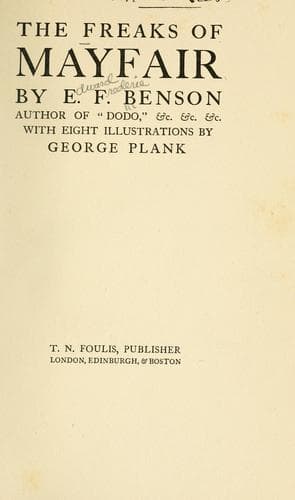
The Freaks of MayfairBenson, E. F. (Edward Frederic)
General
The Freaks of Mayfair
Benson, E. F. (Edward Frederic)
England -- Social life and customs -- 20th century -- Fiction; Humorous stories, English; Short stories, English
A large establishment was of course necessary in order to maintain the
Whittlemere tradition. Half-a-dozen times in the season Lady Whittlemere
had a dinner-party which assembled at eight, and broke up with the
utmost punctuality at half-past ten, but otherwise the two ladies were
almost invariably alone at breakfast, lunch, tea, and dinner. But a
cook, a kitchen-maid, and a scullery-maid were indispensable to prepare
those meals, a still-room maid to provide cakes and rolls for tea and
breakfast, a butler and two footmen to serve them, a lady’s maid to look
after Lady Whittlemere, a steward’s room boy to wait on the cook, the
butler, and the lady’s maid, two housemaids to dust and tidy, a coachman
to drive Lady Whittlemere, and a groom and a stable-boy to look after
the horses and carriages. It was impossible to do with less, and thus
fourteen lives were spent in maintaining the Whittlemere dignity
downstairs, and Miss Lyall did the same upstairs. With such an
establishment Lady Whittlemere felt that she was enabled to do her duty
to herself, and keep the flag of tradition flying. But the merest tyro
in dignity could see that this could not be done with fewer upholders,
and sometimes Lady Whittlemere had grave doubts whether she ought not to
have a hall-boy as well. One of the footmen or the butler of course
opened the front-door as she went in and out, and the hall-boy with a
quantity of buttons would stand up as she passed him with fixed set
face, and then presumably sit down again.
The hours of the day were mapped out with a regularity borrowed from the
orbits of the stars. At half-past nine precisely Lady Whittlemere
entered the dining-room where Miss Lyall was waiting for her, and
extended to her companion the tips of four cool fingers. Breakfast was
eaten mostly in silence, and if there were any letters for her (there
usually were not) Lady Whittlemere read them, and as soon as breakfast
was over answered them. After these literary labours were accomplished,
Miss Lyall read items from the _Morning Post_ aloud, omitting the
leading articles but going conscientiously through the smaller
paragraphs. Often Lady Whittlemere would stop her. ‘Lady Cammerham is
back in town is she?’ she would say. ‘She was a Miss Pulton, a distant
cousin of my husband’s. Yes, Miss Lyall?’
Public-domain text, read in full here on John Shaqi.
Reviews
Reviews
No reviews yet
Be the first to share your thoughts on this work.
Join the Discussion
Join the discussion
Sign in to leave a comment or review.
Sign InorCreate an account