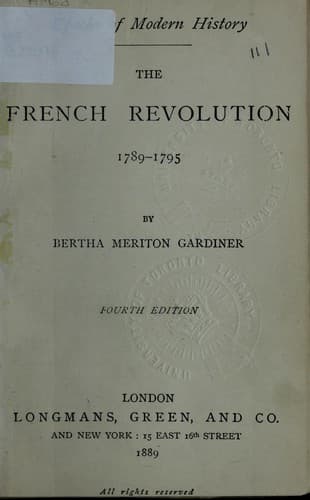
The French Revolution 1789-1795Gardiner, Bertha Meriton
History
The French Revolution 1789-1795
Gardiner, Bertha Meriton
France -- History -- Revolution, 1789-1799
Louis could relieve himself from momentary inconvenience by abandoning
a Minister of whom he was weary, but had no power to stay the course
of events. Those who had lent money to the government deeply resented
Necker’s fall, because they believed him able to secure regular payment
of the interest on the national debt. Desire for social change was
accompanied by desire for political change also. Rousseau had said
that the people was sovereign, and as the incompetency of the crown to
carry out the national will became with each successive ministry more
manifest, ideas long since vaguely floating in men’s minds gathered
strength and consistency. The cause of the American colonies was taken
up with immense enthusiasm. The Declaration of Independence (July
4, 1776), which, in accordance with the principles laid down in the
‘Social Contract,’ asserted that all men were created equal and endowed
with the natural right of overthrowing an unjust government, was hailed
as the enunciation of an universal truth, of which Frenchmen as well as
the colonists might reap the benefit. Meanwhile government in France
grew yearly more utterly weak and helpless. The war with England ended
in 1783, but financial embarrassments increased. ♦Calonne.♦ Calonne,
who became Controller-General the same year, pursued Necker’s system of
borrowing without his justification, and retained office by abstaining
from acts calculated to offend the privileged classes. The demands
of the Queen and the Court were complied with, and abuses destroyed
by Necker again called into existence. ‘If it is possible, madam,’
said the obsequious Minister, on an occasion when the Queen pressed
him for money, ‘it shall be done; if it is impossible, it shall be
done.’ But such squandering of the revenue could not last for ever.
Calonne’s credit broke down, and he was driven as a last resource to
propose the reform of the entire system of administration and taxation.
By publicity he hoped to overcome resistance. He called together an
extraordinary council or assembly of notables, nominated by the King
(February 1787), and laid his propositions before them, thinking that
in the existing state of opinion they would not venture to refuse
support. But this assembly, composed almost entirely of privileged
persons, proved recalcitrant. The majority were against the reforms
proposed, while the few who approved them were determined that they
should be made by an assembly representative of the nation.
♦Brienne.♦
Public-domain text, read in full here on John Shaqi.
Reviews
Reviews
No reviews yet
Be the first to share your thoughts on this work.
Join the Discussion
Join the discussion
Sign in to leave a comment or review.
Sign InorCreate an account