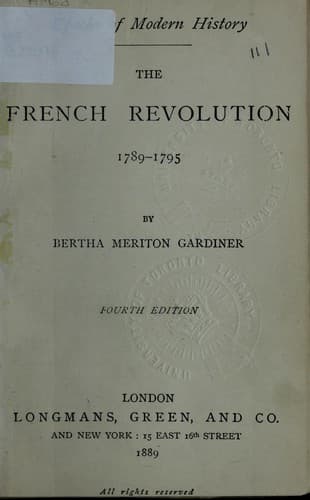
The French Revolution 1789-1795Gardiner, Bertha Meriton
History
The French Revolution 1789-1795
Gardiner, Bertha Meriton
France -- History -- Revolution, 1789-1799
Calonne gave place (1787) to Brienne, Archbishop of Toulouse, the
candidate of the Queen; but the new Minister had no choice except
to take up the plans of his predecessor, and the government became
involved in incessant strife with the Parliaments. The Parliaments
concealed their aversion to the principle of equality of taxation, by
denying the right of the King to impose new taxes without the consent
of the nation, and by demanding the meeting of the States-General.
The government, on its side, sought popularity by coupling edicts
for raising loans and taxes with reforming measures. But it could
obtain no support. The shifting policy which it had so long pursued,
the attempts at reform, made, abandoned, and then made again, had
destroyed confidence alike in its power and its good-will. Hence,
although the Parliaments defended the privileges of nobles and
clergy, their resistance was applauded, because it offered the surest
means of forcing the King’s hand, and leaving him no alternative
but to summon the nation to his aid. Along with equality, the word
‘liberty’ was on every man’s lips. The very nobles, who had so long
opposed administrative and economical change, had themselves become
vehement advocates of political change. More afraid of the crown than
of the classes beneath them, and blind to the complete isolation of
their own order, they looked forward to being at once leaders of a
political revolution and guardians of their own interests. In fact,
the privileged orders had no choice but either to submit at discretion
to the King, or to join in the popular cry for the meeting of the
States-General. Arbitrary attempts made by Brienne to free the crown
of dependence on the Parliaments failed, in the face of resistance
offered by all classes, and brought the country to the verge of actual
insurrection. Disaffection was rife in the army. Peasants and artisans,
excited by expectation of better days, were more ready than before to
rise in insurrection against local authorities, and were less easily
quelled. State bankruptcy impended. There was a deficit in the revenue
of more than 2,000,000_l._, and money was wanting with which to pay
the interest of the national debt. Under such circumstances Louis
reluctantly yielded to the demand made on every side. He declared his
intention of summoning the States-General and in order to regain
confidence restored to the head of the finances his former and still
popular minister, Necker (Aug. 1788).
♦Necker recalled to office.♦
Public-domain text, read in full here on John Shaqi.
Reviews
Reviews
No reviews yet
Be the first to share your thoughts on this work.
Join the Discussion
Join the discussion
Sign in to leave a comment or review.
Sign InorCreate an account