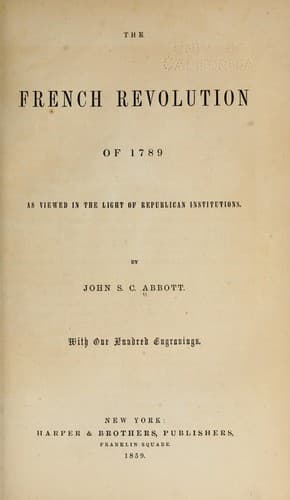
The French Revolution of 1789, as Viewed in the Light of Republican InstitutionsAbbott, John S. C. (John Stevens Cabot)
History
The French Revolution of 1789, as Viewed in the Light of Republican Institutions
Abbott, John S. C. (John Stevens Cabot)
France -- History -- Revolution, 1789-1799
"'By the King of Heaven I care little for your nobility and beauty,
however others may admire you. You may hold it for certain that, if you
do not make amends for your past negligence by vigilant zeal, you will
never obtain any thing from Charles.'"[6]
Wherever Charlemagne led his legions, he baptized the vanquished; and
the conquered tribes and nations called themselves Christians. The
ignorant barbarians eagerly accepted the sacrament for the sake of the
white baptismal robe which was given to each proselyte.
The vast empire of Charlemagne under his effeminate successors rapidly
crumbled to pieces. In ceaseless conflicts and fluctuations the chiefs
of the tribes, or nobles, gradually regained the power which had
been wrested from them by Charlemagne. Upon the ruins of the empire
arose the feudal system, and France became a monarchy but in name.
The throne, shorn of its energies, retained but the shadow of power.
Haughty dukes, surrounded by their warlike retainers, and impregnable
in massive castles which had been the work of ages, exercised over
their own vassals all the prerogatives of royalty, and often eclipsed
the monarch in wealth and splendor. The power of the duke became so
absolute over the serfs who tilled his acres, and who timidly huddled
for protection beneath the ramparts of the castle, that, in the
language of the feudal code, the duke "might take all they had, alive
or dead, and imprison them when he pleased, being accountable to none
but God."
France again became but a conglomeration of independent provinces, with
scarcely any bond of union. The whole landscape was dotted with castles
strongly built upon the river's bluff, or upon the craggy hill. These
baronial fortresses, massive and sombre, were flanked by towers pierced
with loop-holes and fortified with battlements. A ditch often encircled
the walls, and an immense portcullis or suspended gate could at any
moment be let down, to exclude all entrance. The apartments were small
and comfortless, with narrow and grated windows. There was one large
banqueting-hall, the seat of baronial splendor, where the lord met his
retainers and vassals in intercourse in which aristocratic supremacy
and democratic equality were most strangely blended. Every knight swore
fealty to the baron, the baron to the duke, the duke to the king. The
sovereign could claim military service from his vassals, but could
exercise no power over their serfs, either legislative or judicial. It
not unfrequently happened that some duke had a larger retinue and a
richer income than the king himself.
Public-domain text, read in full here on John Shaqi.
Reviews
Reviews
No reviews yet
Be the first to share your thoughts on this work.
Join the Discussion
Join the discussion
Sign in to leave a comment or review.
Sign InorCreate an account