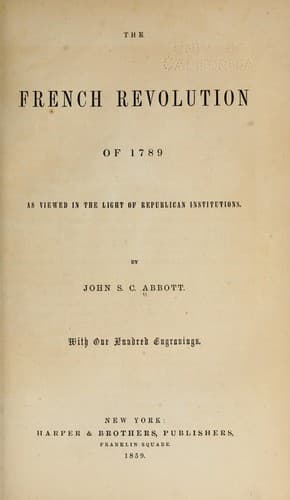
The French Revolution of 1789, as Viewed in the Light of Republican InstitutionsAbbott, John S. C. (John Stevens Cabot)
History
The French Revolution of 1789, as Viewed in the Light of Republican Institutions
Abbott, John S. C. (John Stevens Cabot)
France -- History -- Revolution, 1789-1799
These proud bishops assumed the character and the haughty air of feudal
lords. They scorned to ride upon the lowly mule, but vaulted upon the
back of the charger neighing for the battle. They were ever ready for a
fray, and could strike as sturdy blows as ever came from the battle-axe
of a knight. The vows of celibacy were entirely disregarded. Some took
wives; others openly kept concubines. These younger sons of the nobles,
dressed in the garb of the Church, were found to be such dangerous
characters that there was a general demand that they should be married.
"Laymen are so convinced," says one of the ancient writers, "that
none ought to be unmarried, that in most parishes they will not abide
a priest except he have a concubine." The lords spiritual endeavored
to fashion the Church upon the model of the feudal system. Abbeys and
bishoprics, with all their rich endowments, passed by descent to the
children of the bishops.[7]
An incident which occurred in the year 911 throws much light upon the
rudeness of those barbaric times. Rollo, the chieftain of a band of
Norman pirates, entered the Seine, committing fearful ravages. Charles
IV., appropriately called Charles the Simple, alarmed by his progress
and unable to raise a force sufficient to check him, sent an archbishop
to offer him the possession of Normandy, with the title of hereditary
duke, if he would peaceably take possession of this territory and
swear allegiance to the king. Rollo eagerly accepted the magnificent
offer. In performing the ceremony of swearing fealty, it was necessary,
according to custom, for Rollo to prostrate himself before the king
and kiss his feet. The haughty Norman, when called upon to perform the
ceremony, indignantly drew himself up, exclaiming,
"Never, never will I kiss the foot or bow the knee to mortal man."
After some delay it was decided that the act of homage should be
performed by proxy, and Rollo ordered one of his stalwart soldiers to
press his lip upon the foot of the king. The burly barbarian strode
forward, as if in obedience to the command, and, seizing the foot of
the monarch, raised it high above his head, and threw the monarch
prostrate upon the floor. The Norman soldiers filled the hall with
derisive shouts of laughter, while the king and his courtiers,
intimidated by barbarians so fierce and defiant, prudently concealed
their chagrin.
The Carlovingian dynasty held the throne for two hundred and
thirty-five years. Louis V., the last of this race, died in 987. He was
called, from his indolence and imbecility, the Idler. As he sank into
an inglorious grave, an energetic and powerful noble, Hugh Capet, Duke
of the Isle of France, with vigorous arm thrust the hereditary claimant
into a prison and ascended the throne. Thus was established the third
dynasty, called the Capetian.
Public-domain text, read in full here on John Shaqi.
Reviews
Reviews
No reviews yet
Be the first to share your thoughts on this work.
Join the Discussion
Join the discussion
Sign in to leave a comment or review.
Sign InorCreate an account