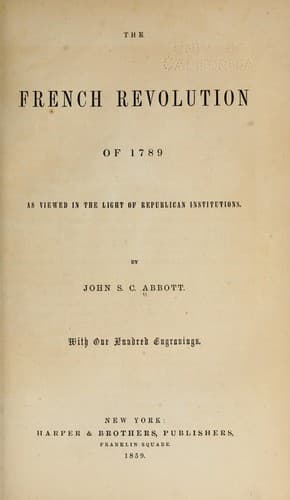
The French Revolution of 1789, as Viewed in the Light of Republican InstitutionsAbbott, John S. C. (John Stevens Cabot)
History
The French Revolution of 1789, as Viewed in the Light of Republican Institutions
Abbott, John S. C. (John Stevens Cabot)
France -- History -- Revolution, 1789-1799
Soon after the succession of Louis XIV. to the throne he became
convinced that the maintenance of the Romish hierarchy was essential
to the stability of his power. He consequently commenced a series of
persecutions of the Protestants, with the determination of driving
that faith entirely from France. In 1662 he issued a decree that no
Protestant should be buried except after sunset or before sunrise.
Protestant mechanics or shop-keepers were not allowed to have
apprentices. Protestant teachers were permitted to instruct only in the
first rudiments of letters, and not more than twelve Protestants were
allowed to meet together for the purposes of worship. No Protestant
woman could be a nurse in the chamber of infancy; no Catholic could
embrace Protestantism or marry a Protestant woman under pain of exile.
Catholic magistrates were empowered to enter the dying chambers of
the Protestants to tease them, when gasping in death, to return to
the Catholic faith. In four years, between 1680 and 1684, more than
twenty royal edicts were issued against the Protestants, decreeing,
among other things, that no Protestant should be a lawyer, doctor,
apothecary, printer, or grocer. Children were often taken by violence
from Protestant parents, that they might be trained in the Catholic
faith.
Madame de Maintenon, the unacknowledged wife of Louis XIV., wished to
bring back into the fold of Rome a young lady, Mademoiselle de Murgay.
She consequently wrote to her brother:
"If you could send her to me you would do me a great pleasure. There
are no other means than violence, for they will be much afflicted in
the family by De Murgay's conversion. I will send you a _lettre de
cachet_ (secret warrant) in virtue of which you will take her into your
own house until you find an opportunity of sending her off."[8]
Such outrages as these were of constant occurrence. Zeal for the
conversion of the Protestants never rose to a higher pitch. At the same
time Louis XIV. could bid defiance to God's commands, and insult the
moral sense of the nation by traveling with his wife and his two guilty
favorites, Madame de Montespan and Madame la Vallière, all in the same
carriage. The profligacy of the ecclesiastics and the debauchery of the
court and the nobles, though less disguised during the wild saturnalia
of the succeeding regency, was never more universal than during this
reign. This was the golden age of kings. Feudality had died, and
democracy was not born. The monarchy was absolute. The nobles, deprived
of all _political_ power, existed merely as a luxurious appendage and
embellishment to the throne, while the people, unconscious of either
power or rights, made no movements to embarrass the sovereign.[9]
Public-domain text, read in full here on John Shaqi.
Reviews
Reviews
No reviews yet
Be the first to share your thoughts on this work.
Join the Discussion
Join the discussion
Sign in to leave a comment or review.
Sign InorCreate an account