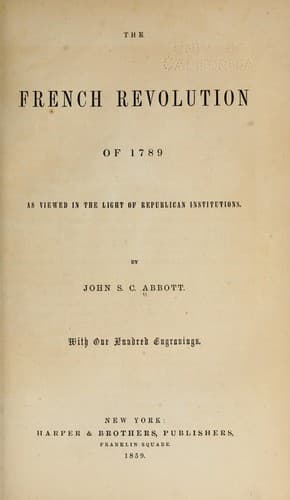
The French Revolution of 1789, as Viewed in the Light of Republican Institutions — John Shaqi
The French Revolution of 1789, as Viewed in the Light of Republican InstitutionsAbbott, John S. C. (John Stevens Cabot)
History
The French Revolution of 1789, as Viewed in the Light of Republican Institutions
Abbott, John S. C. (John Stevens Cabot)
France -- History -- Revolution, 1789-1799
Unfortunately, fatally for the liberties of France, the leading
writers were infidels. Mistaking the corruptions of Christianity for
Christianity itself, they assailed religion furiously, and succeeded
in eradicating from men's souls all apprehensions of responsibility to
God. Nothing could more effectually brutalize and demonize the soul of
man. And yet the Papal Church, as a towering hierarchy, had become
so corrupt, such an instrument of oppression, and such a support of
despotism, that no reform could have been accomplished but by its
overthrow.[28] It was the monarch's right arm of strength; it was the
rampart which was first to be battered down.
The Church had no word of censure for vice in high places. It spread
its shield before the most enormous abuses, and, by its inquisitorial
censorship of the press, protected the most execrable institutions.
The Church, enervated by wealth and luxurious indulgence, had also
become so decrepit as to invite attack. No man could summon sufficient
effrontery to attempt her defense. The only reply which bloated and
debauched ecclesiastics could make to their assailants was persecution
and the dungeon. There were a few truly pious men in the Church; they
did, however, but exhibit in clearer contrast the general corruption
with which they were surrounded.
Diderot, though educated by the Jesuits--perhaps _because_ he was
educated by the Jesuits--commenced his career by an attack upon
Christianity in his _Pensées Philosophiques_. He was sent to prison,
and his book burned by the public executioner. Still, multitudes
read and so warmly applauded that he was incited to form the plan of
the celebrated Encyclopedia which was to contain a summary of all
human knowledge. In this grand enterprise he allied with him the
ablest scholars and writers of the day--Mably, Condillac, Mercier,
Raynal, Buffon, Helvetius, D'Alembert, and others. Nearly all these
men, despising the _Church_, were unbelievers in _Christianity_.
They consequently availed themselves of every opportunity to assail
religion. The court, alarmed, laid a prohibition upon the work, but did
not dare to punish the writers, as they were too numerous and powerful.
Thus infidelity soon became a fashion. Notwithstanding the prohibition,
the work was soon resumed, and became one of the most powerful agents
in ushering in the Revolution.
"Christianity was hated by these philosophers," writes De Tocqueville,
"less as a religious doctrine than as a political institution; not
because the ecclesiastics assumed to regulate the concerns of the other
world, but because they were landlords, seigneurs, tithe-holders,
administrators in this; not because the Church could not find a place
in the new society which was being established, but because she then
occupied a place of honor, privilege, and might in the society which
was to be overthrown."
Public-domain text, read in full here on John Shaqi.
Reviews
Reviews
No reviews yet
Be the first to share your thoughts on this work.
Join the Discussion
Join the discussion
Sign in to leave a comment or review.
Sign InorCreate an account