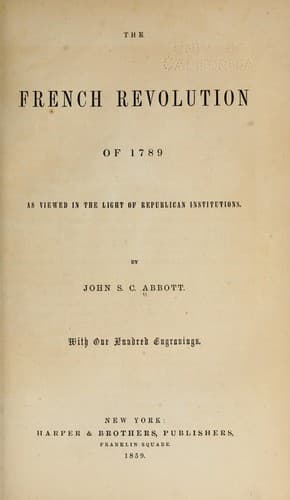
The French Revolution of 1789, as Viewed in the Light of Republican InstitutionsAbbott, John S. C. (John Stevens Cabot)
History
The French Revolution of 1789, as Viewed in the Light of Republican Institutions
Abbott, John S. C. (John Stevens Cabot)
France -- History -- Revolution, 1789-1799
Christianity is the corner-stone of a true democracy. It is the
unrelenting foe of despotism, and therefore despotism has invariably
urged its most unrelenting warfare against the Bible. When papacy
became the great spiritual despotism which darkened the world, the
Bible was the book which it hated and feared above all others. With
caution this corrupt hierarchy selected a few passages upon submission
and obedience, which it allowed to be read to the people, while the
majestic principles of fraternity, upon which its whole moral code is
reared, were vigilantly excluded from the public mind. The peasant
detected with a Bible was deemed as guilty as if caught with the tools
of a burglar or the dies of a counterfeiter.
It was impossible, however, to conceal the fact that the Bible was the
advocate of purity of heart and life. Its teachings created a sense
of guilt in the human soul which could not be effaced. Corrupt men
were consequently eager to reject the Bible, that they might appease
reproachful conscience. Frederick II., of Prussia, an atheist and a
despiser of mankind, became the friend and patron of Voltaire in his
envenomed assaults upon Christianity. Louis XV., anxious to maintain
friendly political relations with Prussia, hesitated to persecute the
recognized friend of the Prussian king. The courtiers, generally with
joy, listened to those teachings of unbelief which relieved them from
the restraints of Christian morality. Thus Christianity had two classes
of vigorous assailants. The first were those who knew not how to
discriminate between Christianity and its corruptions. They considered
Christianity and the Papal Church as one, and endeavored to batter the
hateful structure down as a bastille of woe. Another class understood
Christianity as a system frowning upon all impurity, and pressing ever
upon the mind a final judgment. They were restive under its restraints,
and labored for its overthrow that guilt might find repose in unbelief.
Astonishment is often expressed at the blindness with which the upper
classes of the Old Régime allowed their institutions to be assailed.
"But where," asks De Tocqueville, "could they have learned better.
Ruling classes can no more acquire a knowledge of the dangers they have
to avoid, without free institutions, than their inferiors can discern
the rights they ought to preserve in the same circumstances."[29]
Public-domain text, read in full here on John Shaqi.
Reviews
Reviews
No reviews yet
Be the first to share your thoughts on this work.
Join the Discussion
Join the discussion
Sign in to leave a comment or review.
Sign InorCreate an account