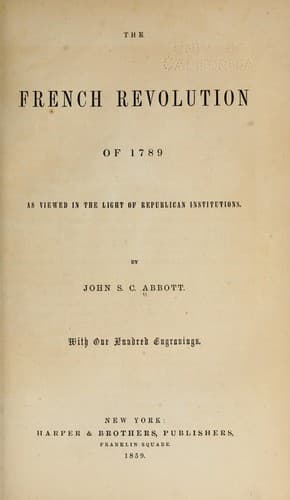
The French Revolution of 1789, as Viewed in the Light of Republican InstitutionsAbbott, John S. C. (John Stevens Cabot)
History
The French Revolution of 1789, as Viewed in the Light of Republican Institutions
Abbott, John S. C. (John Stevens Cabot)
France -- History -- Revolution, 1789-1799
The measureless extravagance of the court had plunged the nation into
a state of inextricable pecuniary embarrassment. The whole burden of
the taxes, in myriad forms, for the support of the throne in Oriental
luxury, for the support of the nobles, who were perhaps the most
profligate race of men the world has ever known; for the support of the
Church, whose towering ecclesiastics, performing no useful functions,
did not even affect the concealment of their vices, and who often vied
with the monarch himself in haughtiness and grandeur; for the support
of the army, ever engaged in extravagant wars, and employed to keep the
people in servitude--all these taxes so enormous as to sink the mass of
the people in the lowest state of poverty, debasement, and misery, fell
upon the unprivileged class alone.
Taxes ran into every thing. The minister who could invent a new tax was
applauded as a man of genius. All the offices of the magistracy were
sold. Judges would pay an enormous sum for their office, and remunerate
themselves a hundred-fold by selling their decisions. Thus justice
became a farce. Titles of nobility were sold, which, introducing the
purchaser into the ranks of the privileged class, threw the heavier
burden upon the unprivileged. All the trades and professions were put
up for sale. Even the humble callings of making wigs, of weighing coal,
of selling pork, were esteemed privileges, and were sold at a high
price. There was hardly any thing which a man could do, which he was
not compelled to buy the privilege of doing. A person who undertook to
count the number of these offices or trades for which a license was
sold, growing weary of his task, estimated them at over three hundred
thousand.[30]
An army of two hundred thousand tax-gatherers devoured every thing. To
extort substance from the starving people the most cruel expedients
were adopted. All the energies of galleys, gibbets, dungeons, and racks
were called into requisition. When the corn was all absorbed, the
cattle were taken. The ground, exhausted for want of manure, became
sterile. Men, women, and children yoked themselves to the plow. Deserts
extended, the population died off, and beautiful France was becoming
but a place of graves.
The people thus taxed owned but one third of the soil, the clergy and
the nobles owning the other two thirds. From this one third the people
paid taxes and feudal service to the nobles, tithes to the clergy, and
imposts to the king. They enjoyed no political rights, could take no
share in the administration, and were ineligible to any post of honor
or profit. No man could obtain an office in the army unless he brought
a certificate, signed by four nobles, that he was of noble blood.
Public-domain text, read in full here on John Shaqi.
Reviews
Reviews
No reviews yet
Be the first to share your thoughts on this work.
Join the Discussion
Join the discussion
Sign in to leave a comment or review.
Sign InorCreate an account