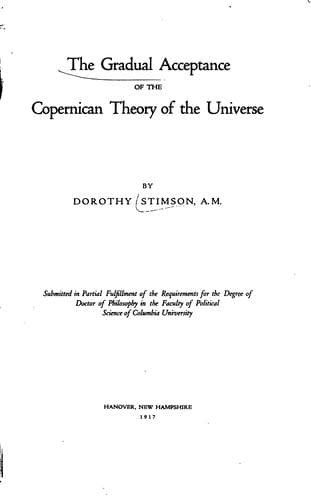
The gradual acceptance of the Copernican theory of the universeStimson, Dorothy
History
The gradual acceptance of the Copernican theory of the universe
Stimson, Dorothy
Astronomy -- History; Copernicus, Nicolaus, 1473-1543; Solar system
Philastrius (d. before 397 A.D.) dealing with various heresies,
denounces those who do not believe the stars are fixed in the heavens
as "participants in the vanity of pagans and the foolish opinions of
philosophers," and refers to the widespread idea of the part the
angels play in guiding and impelling the heavenly bodies in their
courses.[45]
[Footnote 45: Philastrius: _De Hæresibus_, c. 133, (v. 12, p. 1264).]
It would take a brave man to face such attitudes of scornful
indifference on the one hand and denunciation on the other, in support
of a theory the Church considered heretical.
Meanwhile the Church was developing the homocentric notion which
would, of course, presuppose the central position in the universe for
man's abiding place. In the pseudo-Dionysius[46] is an elaborately
worked out hierarchy of the beings in the universe that became the
accepted plan of later centuries, best known to modern times through
Dante's blending of it with the Ptolemaic theory in the _Divine
Comedy_.[47] Isidore of Seville taught that the universe was created
to serve man's purposes,[48] and Peter Lombard (12th cent.) sums up
the situation in the definite statement that man was placed at the
center of the universe to be served by that universe and in turn
himself to serve God.[49] Supported by the mighty Thomas Aquinas[50]
this became a fundamental Church doctrine.
[Footnote 46: Pseudo-Dionysius: _De Coelesti Ierarchia_, (v. 122, p.
10354).]
[Footnote 47: Milman: VIII, p. 228-9. See the _Paradiso_.]
[Footnote 48: Isidore of Seville: _De Ordine Creaturarum_, c. 5, sec.
3, (v. 83, p. 923).]
[Footnote 49: Lombard: _Sententia_, Bk. II, Dist. I, sec. 8, (v. 192,
p. 655).]
[Footnote 50: Aquinas: _Summa Theologica_, pt. I, qu. 70, art. 2.
(_Op. Om. Caietani_, V, 179).]
An adequate explanation of the universe existed. Aristotle, Augustine,
and the other great authorities of the Middle Ages, all upheld the
conception of a central earth encircled by the seven planetary spheres
and by the all embracing starry firmament. In view of the phrases used
in the Bible about the heavens, and in view of the formation of
fundamental theological doctrines based on this supposition by the
Church Fathers, is it surprising that any other than a geocentric
theory seemed untenable, to be dismissed with a smile when not
denounced as heretical? Small wonder is it, in the absence of the
present day mechanical devices for the exact measurement of time and
space as aids to observation, that the Ptolemaic, or geocentric,
theory of the universe endured through centuries as it did, upheld by
the authority both of the Church and, in essence at least, by the
great philosophers whose works constituted the teachings of the
schools.
CHAPTER II.
COPERNICUS AND HIS TIMES.
Public-domain text, read in full here on John Shaqi.
Reviews
Reviews
No reviews yet
Be the first to share your thoughts on this work.
Join the Discussion
Join the discussion
Sign in to leave a comment or review.
Sign InorCreate an account