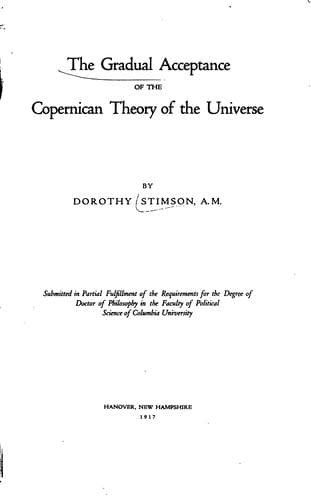
The gradual acceptance of the Copernican theory of the universe — John Shaqi
The gradual acceptance of the Copernican theory of the universeStimson, Dorothy
History
The gradual acceptance of the Copernican theory of the universe
Stimson, Dorothy
Astronomy -- History; Copernicus, Nicolaus, 1473-1543; Solar system
In 1536, the Cardinal Bishop of Capua, Nicolas von Schönberg,
apparently with the intent to pave the way for the theory at Rome,
wrote for a report of it.[134] It is not known whether the report was
sent, and the cardinal died the following year. But that Copernicus
was pleased by this recognition is evident from the prominence he gave
to the cardinal's letter, as he printed it in his book at the
beginning, even before the dedication to the Pope.
[Footnote 134: Prowe: II, 274, note.]
The most widely circulated account at this time, however, was the
_Narratio Prima_, a letter from Georg Joachim of Rhaetia (better known
as Rheticus), written in October, 1539, from Frauenburg to Johann
Schöner at Nürnberg.[135] Rheticus,[136] at twenty-five years of age
professor of mathematics at Wittenberg, had gone uninvited to
Frauenburg early that summer to visit Copernicus and learn for himself
more in detail about this new system. This was rather a daring
undertaking, for not only were Luther and Melancthon outspoken in
their condemnation of Copernicus, but Rheticus was going from
Wittenberg, the headquarters of the Lutheran heresy, into the
bishopric of Ermeland where to the Bishop and the King his overlord,
the very name of Luther was anathema. Nothing daunted, Rheticus
departed for Frauenberg and could not speak too highly of the cordial
welcome he received from the old astronomer. He came for a few weeks,
and remained two years to return to Wittenberg as an avowed believer
in the system and its first teacher and promulgator. Not only did he
write the _Narratio Prima_ and an _Encomium Borussæ_, both extolling
Copernicus, but what is more important, he succeeded in persuading him
to allow the publication of the _De Revolutionibus_. Rheticus returned
to his post in 1541, to resign it the next year and become Dean of the
Faculty of Arts. In all probability the conflict was too intense
between his new scientific beliefs and the statements required of him
as professor of the old mathematics and astronomy.
[Footnote 135: Prowe: II, 426-440.]
[Footnote 136: Ibid: II, 387-405.]
His colleague, Erasmus Reinhold, continued to teach astronomy there,
though he, too, accepted the Copernican system.[137] He published a
series of tables (_Tabulæ Prutenicæ_, 1551) based on the Copernican
calculations to supersede the inaccurate ones by Regiomontanus; and
these were in general use throughout Europe for the next seventy-odd
years. As he himself declared, the series was based in its principles
and fundamentals upon the observations of the famous Nicolaus
Copernicus. The almanacs deduced from these calculations probably did
more to bring the new system into general recognition and gradual
acceptance than did the theoretical works.[138]
[Footnote 137: Ibid: II, 391.]
[Footnote 138: Holden in _Pop. Sci._, 119.]
Public-domain text, read in full here on John Shaqi.
Reviews
Reviews
No reviews yet
Be the first to share your thoughts on this work.
Join the Discussion
Join the discussion
Sign in to leave a comment or review.
Sign InorCreate an account