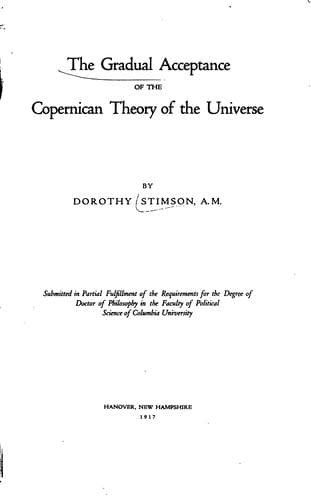
The gradual acceptance of the Copernican theory of the universe — John Shaqi
The gradual acceptance of the Copernican theory of the universeStimson, Dorothy
History
The gradual acceptance of the Copernican theory of the universe
Stimson, Dorothy
Astronomy -- History; Copernicus, Nicolaus, 1473-1543; Solar system
Opposition to the theory had not yet gathered serious headway. There
is record[139] of a play poking fun at the system and its originator,
written by the Elbing schoolmaster (a Dutch refugee from the
Inquisition) and given in 1531 by the villagers at Elbing (3 miles
from Frauenburg). Elbing and Ermeland were hostile to each other,
Copernicus was well known in Elbing though probably from afar, for
there seems to have been almost no personal intercourse between canons
and people, and the spread of Luther's teachings had intensified the
hostility of the villagers towards the Church and its representatives.
But not until Giordano Bruno made the Copernican system the
starting-point of his philosophy was the Roman Catholic Church
seriously aroused to combat it. Possibly Osiander's preface turned
opposition aside, and certainly the non-acceptance of the system as a
whole by Tycho Brahe, the leading astronomer of Europe at that time,
made people slow to consider it.
[Footnote 139: Prowe: II, 233-244.]
CHAPTER III.
THE LATER DEVELOPMENT AND SCIENTIFIC DEFENSE OF THE COPERNICAN SYSTEM.
Copernicus accomplished much, but even his genius could not far outrun
the times in which he lived. When one realizes that not only all the
astronomers before him, but he and his immediate successor, Tycho
Brahe, made all their observations and calculations unaided by even
the simplest telescope, by logarithms or by pendulum clocks for
accurate measurement of time,[140] one marvels not at their errors,
but at the greatness of their genius in rising above such
difficulties. This lack of material aids makes the work of Tycho
Brahe,[141] accounted one of the greatest observers that has ever
lived,[142] as notable in its way perhaps as that of Copernicus.
[Footnote 140: Burckhardt: 8.]
[Footnote 141: The two standard lives of Tycho Brahe are the _Vita
Tychonis Brahei_ by Gassendi (1655) till recently the sole source of
information, and Dreyer's _Tycho Brahe_ (1890) based not only on
Gassendi but on the documentary evidence disclosed by the researches
of the 19th century. For Tycho's works I have used the _Opera Omnia_
published at Frankfort in 1648. The Danish Royal Scientific Society
has issued a reprint (1901) of the rare 1573 edition of the _De Nova
Stella_.]
[Footnote 142: Bridges: 206.]
Public-domain text, read in full here on John Shaqi.
Reviews
Reviews
No reviews yet
Be the first to share your thoughts on this work.
Join the Discussion
Join the discussion
Sign in to leave a comment or review.
Sign InorCreate an account