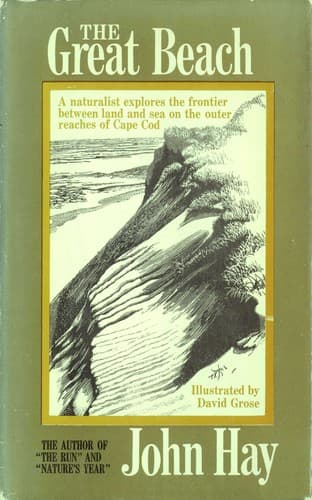
Cape Cod (Mass.) -- Description and travel; Natural history -- Massachusetts -- Cape Cod
A plane shows you a much wider panorama, while diminishing the land,
eliminating the size of locality and local things. It takes you high
enough to see the curve of the earth, the concrete highways like
ribbons across the country, the thin lines of roads and streets, the
checkered fields, patches of lakes, and sprawling cities. A jet plane
cuts across time. You can run after the sun as it falls on the other
side of the world and almost catch it, following the mountain shadows
over America, and since you pass time in that sense, not able to go
faster than the speed of light, but crossing the rhythmic stations of
earth and sun, I have felt it as a longer journey than that involved in
a car or train. What might ordinarily take days is reduced to hours,
but when we landed I have felt the days in me as much as the hours.
We bypass the clock. We go from low to high, bridging a gap between
the individual and the universe, leaving earth’s confinements for
indefinite space, but local time is still inside us.
On the ground, obviously enough, you limit the horizon by the extent of
your vision, and the horizon in turn limits you, but land and water are
held by their relationships to space and to each other. Apparently all
climatic cycles are world-wide; and the immediate, local weather is in
part dependent on the weather behind and ahead of it. In the same way
the only limit to the landscape is the globe itself. Its reaches go out
of sight, if not of universal measure.
This seaside country often gives you the feeling that the sky is the
limit. One opening beyond the trees, another mile revealed, and the
earth and sea from the top of a dune, the world you stand on, may
become exalted in its scope. Perhaps people climb hills and mountains
not only to get to the top, or as an activity in its own right--reasons
often given in answer to questions that may be of no great value--but
to join the range of the world, to be up and outward bound, and above
all to have a sense of the unities in and beyond them. A greater
landscape means a new communion.
I once climbed a small mountain in Maine with a group of Sea Scouts.
We stopped just below its summit, where there was a bowl surrounded
by rocky heights and slopes and holding clear, cold water, the size
of a small pond. The boys stripped and went in swimming, and all
their excited yelling as they jumped in and out of the water resolved
along the rock faces and deep crevices into echoes that rang and
choired--heard from above--like _Te Deums_ in a cathedral. And far down
and around for hundreds of miles were the houseless mountains flaming
with color.
One of the boys asked: “How many acres do you think there are?”
For all its matter-of-factness, his question brought us in touch with
massive distance, an over-all light and wind above the great carpets
of color, a landscape running with power, having a latent silence, a
prodigious weight and matter.
Public-domain text, read in full here on John Shaqi.
Reviews
Reviews
No reviews yet
Be the first to share your thoughts on this work.
Join the Discussion
Join the discussion
Sign in to leave a comment or review.
Sign InorCreate an account