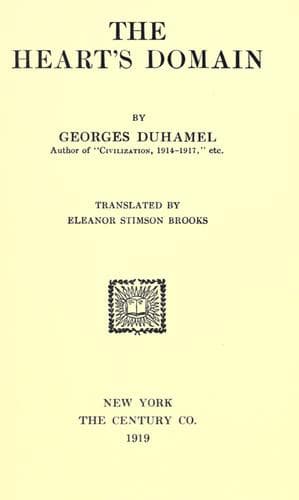
French essays -- Translations into English; World War, 1914-1918 -- Influence
In this matter we exhibit a special sensibility that may be compared
to the tropisms which push plants up toward the light or make them
struggle against gravitation. We go toward some and flee from others,
regardless of our interests or our prejudices.
The man whose companionship we seek because it stimulates us is not
necessarily he who strives to give us a good opinion of ourselves.
Often he is taciturn, sometimes surly, occasionally ironical and
cutting. Nevertheless, there emanates from his whole person something
like approbation, a confession of confidence. Even if he insists,
harshly, noisily, upon calling attention to our faults, he does not
make us despair of ourselves and our future. And if he never speaks to
us about ourselves we yet know, by some imperceptible gesture, by some
tone in his voice, by a gleam in his eye, that he is interested in us.
Every time we leave him we like him better, we like ourselves better,
we like all humanity better, we look at everything with a smile, we are
as full of plans as a tree in April.
The other sort of man, on the contrary, is forever deluding himself.
He pursues before our very eyes an end which we see, with grief and
bitterness, he regularly fails to attain. Whatever he does, whatever
he says, he always shows us that he is a stranger to us, that he is
superior and that we do not interest him. Even in his manner of wishing
to give us his attention, he exhibits a certain difficulty in seeing
us at all. If he tries to seem talkative, important, majestic, his
natural gifts turn against him; his cordiality disgusts us, his bearing
irritates us, his self-importance makes us want to laugh. We cannot
forgive him anything, and especially the fact that we always leave him
with the same vague depression, the same disgust of life, and the same
distrust of our own undertakings. What we are always escapes him, and
although what he is does not escape us, we are discouraged by him all
the same.
We must be the first of these two men, he who is, amid all things,
in spite of all things, a rich man, he whom the poet of the _Livre
d’amour_ justly called “a conqueror.”
XII
You must not violate your gifts, you must simply study their
possibilities. It is what we do with trees and animals in which we are
able to instil virtues they do not seem to possess at all naturally.
Public-domain text, read in full here on John Shaqi.
Reviews
Reviews
No reviews yet
Be the first to share your thoughts on this work.
Join the Discussion
Join the discussion
Sign in to leave a comment or review.
Sign InorCreate an account