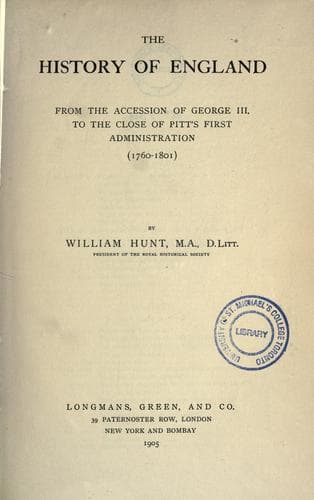
The history of England, from the accession of George III. to the close of Pitt's first administration, 1760-1801Hunt, William
History
The history of England, from the accession of George III. to the close of Pitt's first administration, 1760-1801
Hunt, William
Great Britain -- History -- George III, 1760-1820
Brought up among bed-chamber women and pages, in an unwholesome
atmosphere of petty intrigue, and carefully kept from contact with the
world, George had the failings which such a system might be expected to
produce. His mother certainly succeeded in implanting in his heart
religious principles which he preserved through life, and she turned him
out a pure-minded and well-bred young man; but the faults in his
character were confirmed. He was uncharitable in his judgments of others
and harsh in his condemnation of conduct which he did not approve. His
prejudices were strengthened; he put too high a value on his own
opinions and was extremely stubborn. In dealing with men, he thought too
much of what was due to himself and too little of what was due to
others. As a lad he lacked frankness, and in later life was disingenuous
and intriguing. When he was displeased his temper was sullen and
resentful. He was always overcareful about money, and in old age this
tendency developed into parsimony. His education was deficient; it had
not been carried on steadily, and he had been allowed to indulge a
constitutional inertness. Though he overcame this habit, the time which
he had lost could not be made up for, and ideas which might have been
corrected or enlarged by a more thorough education, remained firmly
fixed in his mind.
[Sidenote: _THE EARL OF BUTE._]
Among these ideas were an exaggerated conception of the royal
prerogative and the belief that it was his duty as king to govern as
well as to reign. His mother's constant exhortation to him, "George, be
a king," fell upon willing ears, and appears to have been enforced by
his tutors. A more powerful influence on the mind of the young prince
than that of any of his tutors was exercised by John Stuart, Earl of
Bute, his mother's chief friend and adviser. He was a fine showy man,
vain of his handsome person, theatrical in his manners, pompous, slow
and sententious in his speech. His private life was respectable; he had
literary and scientific tastes, and a good deal of superficial
knowledge. His abilities were small; he would, George's father used to
say, "make an excellent ambassador in any court where there was nothing
to do".[2] He lacked the steadfast self-reliance necessary to the part
which he undertook to play, and had none of the dogged resolution of his
royal pupil. His enemies freely accused him of falsehood; he was
certainly addicted to intrigue, but he was probably too proud a man to
utter direct lies. The friendship between him and the princess was close
and lasting. It was generally believed that he was her paramour, but for
this there is no real evidence. It would have been contrary to the
character of the princess, and the assertion seems to have been a
malicious scandal. George liked him, and when he was provided with a
household of his own in 1756, he persuaded the king to put the earl at
the head of it as his groom of the stole. Though utterly incompetent for
Public-domain text, read in full here on John Shaqi.
Reviews
Reviews
No reviews yet
Be the first to share your thoughts on this work.
Join the Discussion
Join the discussion
Sign in to leave a comment or review.
Sign InorCreate an account