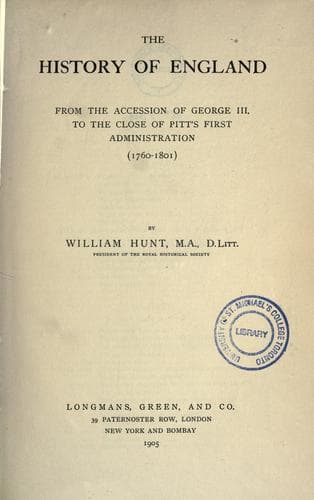
The history of England, from the accession of George III. to the close of Pitt's first administration, 1760-1801Hunt, William
History
The history of England, from the accession of George III. to the close of Pitt's first administration, 1760-1801
Hunt, William
Great Britain -- History -- George III, 1760-1820
the task, Bute instructed the prince in the duties of kingship; he
encouraged him in the idea that a king should exercise a direct control
over public affairs, and is said to have borrowed for him a portion of
Blackstone's then unpublished _Commentaries on the Laws of England_ in
which the royal authority is magnified.
George's political system was, it is evident, largely based on
Bolingbroke's essay _On the Idea of a Patriot King_. In this essay
Bolingbroke lays down that a king who desires the welfare of his people
should "begin to govern as soon as he begins to reign," that he must
choose as his ministers men who "will serve on the same principles on
which he intends to govern," and that he must avoid governing by a
party. Such a king will unite his people, and put himself at their head,
"in order to govern, or more properly subdue, all parties". This
doctrine seemed specially appropriate to the state of affairs at
George's accession. During the last two reigns the power of the crown
had dwindled. Neither George I. nor George II. had cared for, or indeed
understood, domestic politics, and the government had fallen into the
hands of the whig party which became dominant at the Revolution. The
whigs posed as defenders of the Hanoverian house and of the principles
of 1688. Those principles limited the exercise of the prerogative, but
they did not involve depriving the crown of all participation in the
government. The whig party exaggerated them, and while the fortunes of
Hanover and continental affairs absorbed the attention of the king, they
completely usurped the government of the country. They were strong in
the house of lords, and secured their position in the commons by
employing the patronage of the crown, the money of the nation, and their
own wealth and influence to control the borough elections. For nearly
fifty years a small number of whig lords shared the government of the
country among themselves. During Walpole's administration the whigs
became split into sections. Several of the more powerful lords of the
party had each his own following or "connexion" in parliament, composed
of men bound to him by family ties, interest, or the gift of a seat.
These sections, while they agreed in keeping the crown out of all part
in the government, and the tories out of all share in the good things
which the crown had to bestow, struggled with one another for office.
[Sidenote: _THE KING INTENDS TO RULE._]
Public-domain text, read in full here on John Shaqi.
Reviews
Reviews
No reviews yet
Be the first to share your thoughts on this work.
Join the Discussion
Join the discussion
Sign in to leave a comment or review.
Sign InorCreate an account