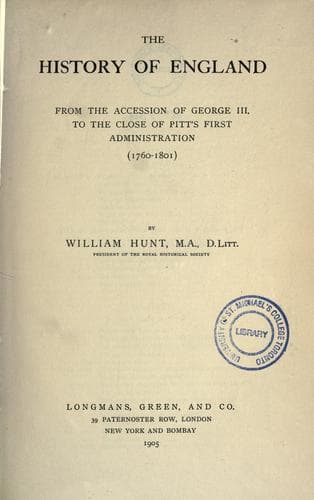
The history of England, from the accession of George III. to the close of Pitt's first administration, 1760-1801Hunt, William
History
The history of England, from the accession of George III. to the close of Pitt's first administration, 1760-1801
Hunt, William
Great Britain -- History -- George III, 1760-1820
Meanwhile the tories were left out in the cold. So long as jacobitism
was a danger to the state, this was not a fair cause of complaint, for
many tories had corresponded with the exiled princes. By 1760, however,
tories had become as loyal as whigs. George was fully determined to put
an end to this state of things: he would be master in his own kingdom;
he and not the whigs should govern England. He naturally rejoiced to see
the tories, a large and important body of his subjects, reconciled to
the throne; and as he had been brought up in tory principles, he
welcomed with peculiar pleasure the support of the party of prerogative.
The tories were no longer to be neglected by the crown; the whig
monopoly was to be brought to an end. He did not contemplate taking
political power from one party in order to vest it in another. He
designed to rule independently of party; no political section was
necessarily to be excluded from office, but no body of men, whether
united by common principles or common interest, was henceforth to
dictate to the crown. To be willing and able to carry on the government
in accordance with his will was to be the sole qualification for a share
in the administration. Ministers might or might not be agreed on matters
of the first importance; all the agreement between them which was
necessary was that each in his own sphere should act as an agent of the
king's policy.
The system was not so impossible as it would be at present. The idea of
the cabinet as a homogeneous body, collectively responsible to
parliament, was not yet established. Government was largely carried on
by ministers working more or less independently of one another. In 1760
the cabinet, an informal committee of the privy council, was an
institution of a different character from that of to-day. During the
last two reigns it had included, along with the ministers holding the
chief political offices, whether of business or dignity, certain great
court officials, and some other personages of conspicuous position whose
assistance might be useful to the government. Nominally the "lords of
the cabinet" were fairly numerous. They did not all take an equal share
in government. The king's "most serious affairs" were directed by not
more than five or six of them, who formed a kind of inner cabinet, the
first lord of the treasury, the two secretaries of state, one or more of
the principal supporters of the administration, and generally the lord
chancellor. They discussed matters privately, sometimes settling what
should be laid before a cabinet meeting, and sometimes communicating
their decisions to the king as the advice of his ministers, without
submitting them to the cabinet at large.[3] Outside this small inner
circle the lords of the cabinet held a position rather of dignity than
of power, and some of them rarely attended a cabinet meeting.[4] This
arrangement was mainly due to the long predominance of Sir Robert
Public-domain text, read in full here on John Shaqi.
Reviews
Reviews
No reviews yet
Be the first to share your thoughts on this work.
Join the Discussion
Join the discussion
Sign in to leave a comment or review.
Sign InorCreate an account