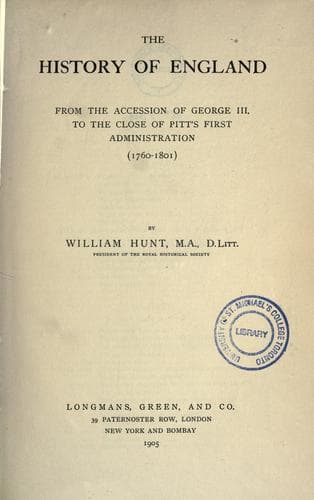
The history of England, from the accession of George III. to the close of Pitt's first administration, 1760-1801 — John Shaqi
The history of England, from the accession of George III. to the close of Pitt's first administration, 1760-1801Hunt, William
History
The history of England, from the accession of George III. to the close of Pitt's first administration, 1760-1801
Hunt, William
Great Britain -- History -- George III, 1760-1820
Walpole and to the overwhelming political influence of a few great whig
houses. The strife among the whigs which followed Walpole's retirement
and the critical character of foreign affairs tended to increase the
number of councillors who commonly took part in cabinet business.
[Sidenote: _THE CABINET._]
The first cabinet of George III. as settled with reference to a meeting
held on November 17, consisted of the keeper of the great seal (Lord
Henley), the president of the council (Lord Granville), the two
secretaries of state (Pitt and Holdernesse), the Duke of Newcastle
(first lord of the treasury), Lord Hardwicke (ex-chancellor), Lord Anson
(first lord of the admiralty), Lord Ligonier (master-general of the
ordnance), Lord Mansfield (lord chief-justice), the Duke of Bedford
(lord-lieutenant of Ireland) and the Duke of Devonshire (lord
chamberlain). If Lord Halifax (president of the board of trade) pleased,
he might attend to give information on American affairs; and Newcastle
suggested that Legge (the chancellor of the exchequer, whose office, as
finance was then largely managed by the first lord of the treasury, was
of less importance than it soon became) and the "solicitor" (Charles
Yorke, solicitor-general) should also be summoned.[5] Soon afterwards
Bute was appointed groom of the stole to the king and entered the
cabinet.[6] After 1760 the cabinet began to assume its later form;
questions of the highest importance were debated and decided on in
meetings of eleven or twelve councillors, and in 1761 Hardwicke
complained that the king's "most serious affairs" were discussed by as
many as would in earlier days have formed a whole cabinet.[7] From 1765
the existence of an inner circle becomes less distinct, though at all
times a prime minister naturally takes counsel privately with the most
prominent or most trusted members of his government. Non-efficient
members of a cabinet appear more rarely until, in 1783, they disappear
altogether. The old inner cabinet becomes expanded into a council
consisting generally of high political officers, and the members, ten or
twelve in number, discuss and settle the weightiest affairs of state.
With the critical negotiations with France in 1796 came a new
development; the prime minister, the younger Pitt, and Lord Grenville,
the foreign secretary, arranged that the British ambassador should write
private despatches for their information, and others of a less
confidential character which might be read by the cabinet at large.[8]
Here a new inner cabinet is foreshadowed. It differed from the old one:
that arose from the small number who were entrusted with an actual share
in the government; this, from the fact that the number of the king's
confidential servants was so large that it was advisable that certain
matters of special secrecy should only be made known to and discussed by
two or three. The subsequent increase of the council promoted the
Public-domain text, read in full here on John Shaqi.
Reviews
Reviews
No reviews yet
Be the first to share your thoughts on this work.
Join the Discussion
Join the discussion
Sign in to leave a comment or review.
Sign InorCreate an account