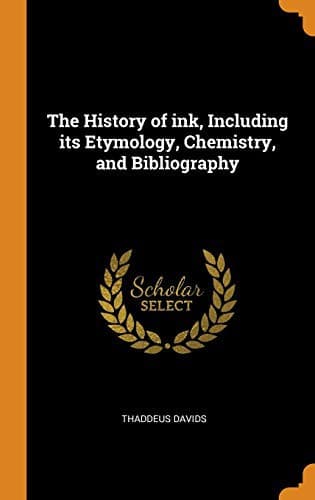
The History of Ink, Including Its Etymology, Chemistry, and Bibliography — John Shaqi
The History of Ink, Including Its Etymology, Chemistry, and BibliographyDavids, Thaddeus
History
The History of Ink, Including Its Etymology, Chemistry, and Bibliography
Davids, Thaddeus
Ink
Sanscrit, Kali, (Black.)
Armenian, Syuaghin.
We might amuse ourselves by extending this tabular list indefinitely.
Enough, however, has been already shown to illustrate a few remarkable
facts which we wish to present that are connected with the etymology of
our subject; but we present a page of Lithographic illustrations which
will enable any “curious reader” to trace the word further.
No dictionary of the English language gives us any help or light about
the matter. Webster suggests “_inchiostro_,” (the Italian word,) as the
source of derivation; and all the Italian lexicographers agree that
_inchiostro_ is from the later Latin ENCAUSTUM, which is in fact Greek,
Εγκαυστον, (Encauston,) “_burned-in_ or corroded.” Encaustum became
corrupted into “_enchaustrum_,” from which the transition to
“_inchiostro_,” is by the regular form of derivation from the Latin to
the Italian,—the L before a vowel giving place to a short I—as “_piano_”
from PLANUS. (The CH, in Italian is always sounded hard, like the
English K.)
Leaving the French word _encre_ as on the middle ground between
different etymologies, and affording no light either way,—we find the
Spanish and Portugese “_tinta_,” and the German (a language widely
remote from those of the Iberian peninsula in origin and affinities)
“_dinte, tinte and tincta_,” forcibly reminding us of the Latin
participle TINCTUS, TINCTA, TINCTUM, from the verb TINGO, which is
represented in English by TINGE, and other derivatives, such as
“_tincture_,” &c. We cannot refuse to recognize the Holland-Dutch
“_Inkt_” as from the same root to which we have thus traced the
corresponding word in a language which we may call its “cousin-German;”
and it is hard to exclude the Old French “_Enque_” and modern “_Encre_”
from this circle of relationship.
Then, we are somewhat impressed by the discovery of the word _Ingvas_ in
the Illyrian, a language of the Slavonic (or more properly Slovenic)
stock, like the Polish,—and, like that, enriched by words derived from
the Latin. The Polish, however, presents us with the actual Graeco-Latin
_Encaustrum_.
Still more remote from the English and Italian, we find among the
Orientals of the Shemitish race, ANGHAS and NIKSON in the Arabic, and
N’KASHO in the Chaldee, with a manifest resemblance in sound, and with
an actual possession of the same elements and radical letters, N. K. Yet
we do not think of suggesting that these words had a common origin with
the corresponding ones in European Languages, though so nearly
coincident in sound. The case is simply one of accidental resemblance, a
remarkable coincidence,—(because occurring at three different and remote
points,) but yet a coincidence not wholly unparalleled.
Public-domain text, read in full here on John Shaqi.
Reviews
Reviews
No reviews yet
Be the first to share your thoughts on this work.
Join the Discussion
Join the discussion
Sign in to leave a comment or review.
Sign InorCreate an account