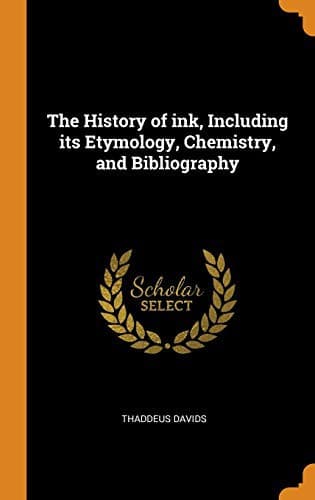
The History of Ink, Including Its Etymology, Chemistry, and BibliographyDavids, Thaddeus
History
The History of Ink, Including Its Etymology, Chemistry, and Bibliography
Davids, Thaddeus
Ink
The probability is that the English word, like the Dutch, German,
Spanish, &c., came from the Latin TINCTUM, but it may be left “an open
question;” for if we had not these instances to direct the formation of
our opinions, we should have no hesitation in acknowledging the Italian
_Inchiostro_ as the true ETYMON; just as, if we had neither of these in
view, we might suspect the origin of our word to be in the Oriental
ANGHAS or NIKSON.
The Ethiopic KALAMA at first sight appears to be related to the
Hindustani KALI; but the latter is merely the word in all the languages
of Hindustan for black,—while the former is but a modification of the
Greek and Latin CALAMUS, a _reed_ or pen,—the instrument (naturally
enough) giving its name to the liquid which was essential to its use.
The word ENCAUSTUM connects, in a very interesting and instructive
manner, both with the history and the chemistry or manufacture of our
modern inks, and is a satisfactory demonstration of the utility of such
etymological researches as those in which we have been here indulging.
The one great distinction between the ancient and the modern inks is
this: The old inks were PAINTS; the writing inks now in use by all
nations (excepting those of Southern Asia) are DYES. That is the whole
difference.
It would be well to give a definition or limitation of the words
“Ancient” and “Modern.” No one has done it hitherto. We will not attempt
to fix the point precisely, but may reasonably say that the period
intervening between September, A.D. 410, (when Rome was taken by ALARIC
and his Visigoths) and December 25, A.D. 800, (when Karl the Great,
otherwise called Charlemagne, was crowned in Rome by Pope Leo with the
title of Emperor of the Holy Roman Empire) contains the interval between
antiquity and modern times.
The introduction of Paper as the common material upon which significant
characters were to be marked must have had a great agency in producing a
change in the composition of the liquid employed in making the marks.
PARCHMENT was the substance in use, among all the European nations, as
the substratum of manuscript, from the time when the Egyptian _papyrus_
went out of fashion. Both the parchment and the papyrus were written
upon, by Romans, Greeks and Hebrews, with pens made of small reeds,
dipped in a fluid composed of _carbon_, (not dissolved, but) held in a
state of suspension by an oil or a solution of gum.
The letters were originally painted on the surface of the papyrus,
parchment, board, or other material so employed—the ink not being
imbibed or absorbed by the substance on which it was shed, but remaining
on the surface, capable of being removed by washing, scraping, rubbing,
or any similar process. The surface thus cleansed was then in a state to
receive a new inscription; so that erasions and inscriptions might be
indefinitely repeated upon it, as upon a modern sign-board.
Public-domain text, read in full here on John Shaqi.
Reviews
Reviews
No reviews yet
Be the first to share your thoughts on this work.
Join the Discussion
Join the discussion
Sign in to leave a comment or review.
Sign InorCreate an account