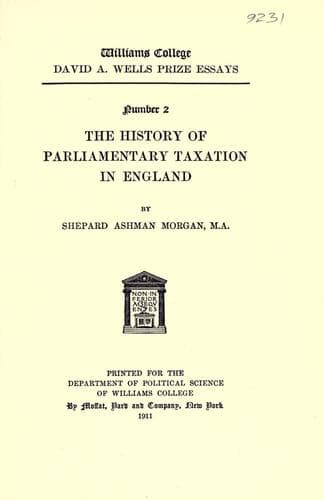
The History of Parliamentary Taxation in EnglandMorgan, Shepard Ashman
History
The History of Parliamentary Taxation in England
Morgan, Shepard Ashman
Taxation -- Great Britain; Taxation -- Great Britain -- History
During the whole period from the coming of the Normans in 1066 to the
signing of Magna Carta in 1215 there can be brought forward only two
or three instances of assent by the National Council to taxes levied
by the king, and these few instances are at best equivocal. They
are insufficient to justify the belief that the National Council had
any final power over the levying of taxation. But the period is not
altogether gray; it concludes with the enunciation in Magna Carta of
rights which cast a halo of color over the whole subsequent narrative
of the struggle for parliamentary taxation.
[William the Conqueror 1066-1087]
William the Conqueror was precisely the man most likely to exercise
supreme control over taxation. Elected to the kingship according to
the Saxon forms and with his title to the crown backed up by force of
arms, he created a system of government of which he himself was the
center and in which his authority, even to the vassals of vassals, was
supreme.[14] With his thirst for power thus satisfied he was given a
free hand to indulge his besetting sin of avarice. Small wonder was it
therefore that he clung to the revenues of his predecessors and added
new imposts of his own.
[His National Council]
Nevertheless, notwithstanding the absolutist character of the king,
William retained the theory and for the most part the form of the Saxon
Witan. Never, however, did the Norman assemblies exercise independent
legislative or executive functions.[15] The holding of land, as a
prerequisite to membership in the National Council, was under William
an uncertain factor; the membership continued to include, generally
speaking, the same officers, ecclesiastics, and nobles as composed
the Witenagemot. The powers of this assembly were probably not great;
at any rate, the magnates of the period considered attendance not
as a right or a privilege or even as an advantage, but merely as a
necessary duty toward the royal person. The king consulted the magnates
on almost every piece of legislation, and stated in the subsequent
promulgation of the laws that he had obtained their advice. But in the
case of a strong king, such as was the Conqueror, the consultation
must have been scarcely more than a statement of the royal will and a
formal acquiescence. The holding of these assemblies took place at
the crowning days of the king, at Christmas, Easter, and Whitsuntide,
generally in London, Winchester, and Gloucester.
[Its part in taxation]
[Instance of the Danegeld, 1084]
Public-domain text, read in full here on John Shaqi.
Reviews
Reviews
No reviews yet
Be the first to share your thoughts on this work.
Join the Discussion
Join the discussion
Sign in to leave a comment or review.
Sign InorCreate an account