The History of Parliamentary Taxation in England — John Shaqi
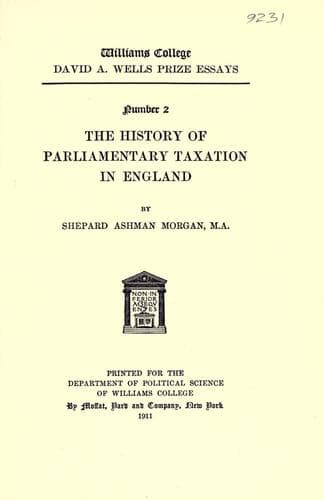
The History of Parliamentary Taxation in EnglandMorgan, Shepard Ashman
History
The History of Parliamentary Taxation in England
Morgan, Shepard Ashman
Taxation -- Great Britain; Taxation -- Great Britain -- History
In the matter of taxation, it is probable as in the case of other
legislation that the Conqueror advised with his Council, though the
evidence pointing toward such a conclusion is entirely of a later
date. But in so far as practical advantage to the payers of the taxes
was concerned, the power might quite as well have lain solely in the
hands of the king; if indeed the Conqueror did secure the assent of
the Council, it was no more than an instance of his policy of adhering
to the forms of law while making the practices under it serve his
own purposes. The reimposition in 1084 of the Danegeld which William
revived as an occasional instead of a regular tax, is not stated by
the chronicler as receiving assent from the Council; the king is
said to have “received six shillings from every hide.”[16] Roger of
Wendover’s Chronicle of the same year brands this exaction as an
“extortion,”[17] by which we are scarcely to understand a tax granted
in any modern sense by the chief legislative body of the kingdom. The
Saxon Chronicler speaking of the same imposition says, “The king caused
a great and heavy tax to be raised throughout England, even seventy-two
pence on every hide of land.”[18] The amount of such an impost, if
drawn from two-thirds of the hidage of the kingdom, would be a sum
approximating £20,000.[19] It is unlikely that an exaction of so great
magnitude could have been levied without the assent of the Council if
the Conqueror was under any obligation to obtain their consent or even
their advice; and it is still more unlikely that four chroniclers of
the events of that year should have let pass unnoted a vote of assent
if it had been passed by the National Council. We are therefore to
conclude that either the Conqueror levied the tax without consulting
his Council at all, or that he did consult them, and that their assent
was of so formal and valueless a nature as not to deserve notice in the
records of the year.[20]
[Domesday Survey, 1086]
The year 1086 witnessed the Domesday Survey. By it William obtained a
detailed register of the land and its capacity for taxation. To the
administrative side of taxation the Survey is of supreme importance,
since the valuation of land thus arrived at was never entirely
superseded as a definite and fair basis for the laying of taxes; to
the actual granting of the tax, however, its importance is of much
less degree. In such light the interest centers chiefly on the fact
that representatives were elected from every hundred upon whose sworn
depositions the information that William wanted was obtained.
[William Rufus, 1087-1100]
Public-domain text, read in full here on John Shaqi.
Reviews
Reviews
No reviews yet
Be the first to share your thoughts on this work.
Join the Discussion
Join the discussion
Sign in to leave a comment or review.
Sign InorCreate an account